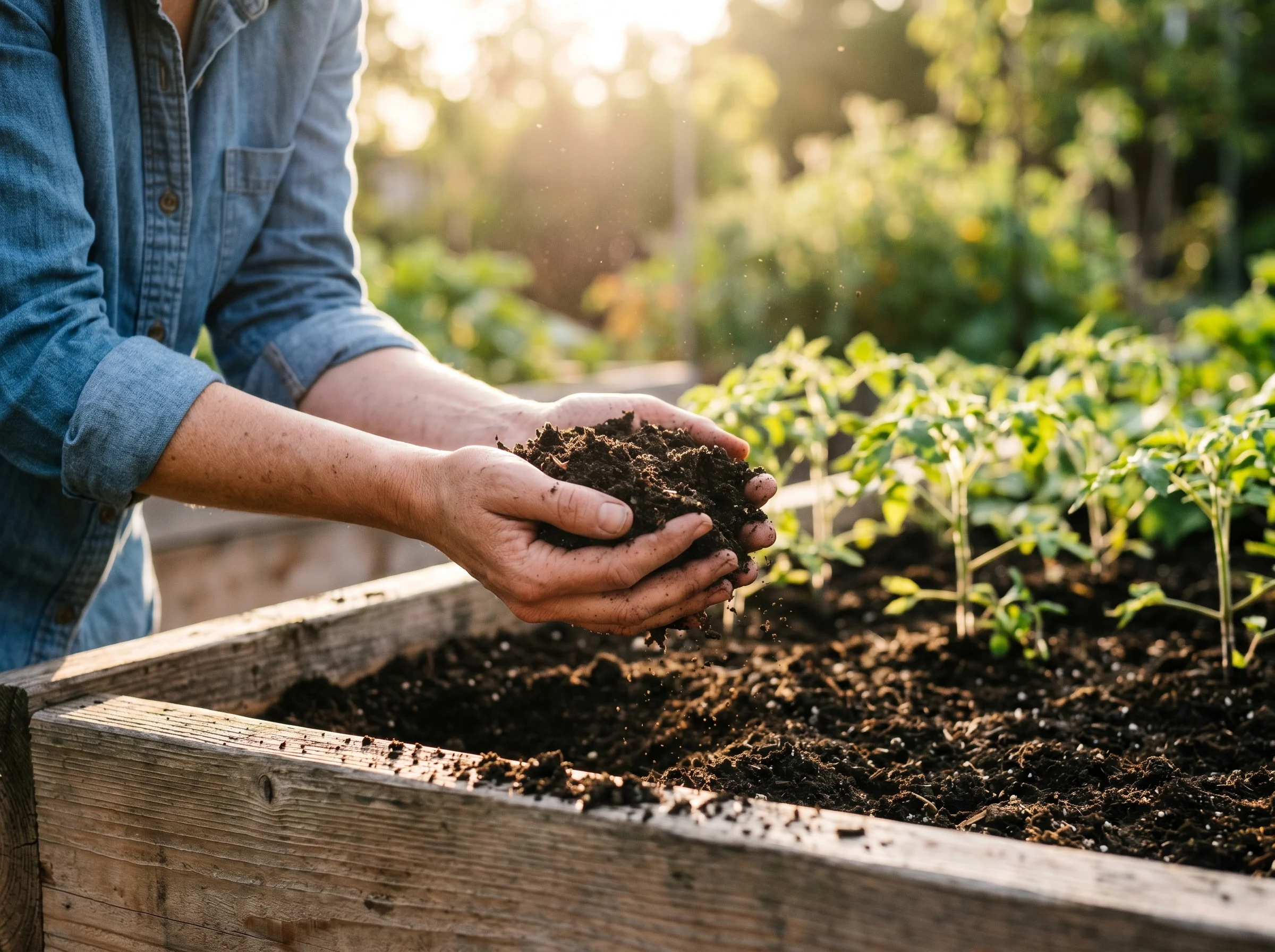
| 🟢 QUICK ANSWER BOX Organic gardening means growing food without synthetic fertilizers or chemical pesticides—focusing instead of soil health, natural pest control, and building a living ecosystem. Beginners can start with raised beds or containers, using compost, organic fertilizers, and easy crops like radishes, beans, and cherry tomatoes. Even one pot on a sunny balcony is a successful organic garden. |
INTRODUCTION – WHY ORGANIC GARDENING IS SIMPLER THAN YOU THINK
The first time you harvest a warm cherry tomato straight from your own garden, it completely changes how you think about food.
I still remember mine. A Sungold—small and orange, so sweet it tasted more like candy than a vegetable. I’d grown it in a single raised bed in my backyard in Zone 6b. I had no idea what I was doing. I overwatered everything. I planted two weeks before my last frost date and lost three seedlings overnight. My first basil plant survived entirely by accident.
But that one tomato made every single mistake worth it.
Here’s what nobody tells you before you start: organic gardening is not complicated. The barrier isn’t knowledge it’s the overwhelming amount of conflicting advice that makes a simple, natural process sound impossibly technical.
In this complete guide to organic gardening for beginners, you’ll learn exactly how to choose your location, prepare your soil the organic way, pick the right starter crops, manage pests without chemicals, and water correctly from your very first weekend of digging.
By the end, you’ll have a clear starting plan, the exact tools you need, the five best beginner crops, and a daily maintenance routine that takes five minutes.
Let’s grow something real.
What Organic Gardening Really Means
Organic gardening means growing plants without synthetic fertilizers or chemical pesticides. But that definition only tells you what it isn’t. Here’s what it actually is.
Organic gardening is a living ecosystem approach. Instead of forcing plant growth artificially with synthetic inputs, you build a biological system that feeds itself. You focus on soil health, biodiversity, and long-term fertility. Your garden becomes more productive every season because you’re building something rather than depleting it.
Three things define the organic approach:
- Growing without synthetic chemicals feeding the soil, not bypassing it with artificial shortcuts
- Encouraging microbial life, earthworms, and beneficial insects as active partners in your garden ecosystem
- Thinking in seasons and years rather than just the current harvest
The great news: this works on balconies, in backyards, on rooftops, and in containers on a kitchen windowsill. You can start small, start inexpensively, and start this weekend.
Benefits of Organic Gardening
Better Flavor and Fresher Produce
There is a moment every first-time organic gardener experiences: eating a tomato or a handful of lettuce they grew themselves and realizing that what they’ve been buying from supermarkets is a pale, flavorless imitation.
Vegetables grown in mineral-rich, biologically active soil develop significantly more complex sugars and flavor compounds than those grown with synthetic fertilizers. The taste difference in homegrown vegetables is real, measurable, and immediately noticeable.
Harvest timing plays an enormous role. You pick when the fruit is actually ripe not when it’s engineered to survive two weeks in a distribution warehouse. That tomato you pull warm from the vine at peak ripeness? It is genuinely different food from anything in a store.
Safer Gardening for Families and Pets
Reduced chemical exposure is one of the most practical reasons families choose organic gardening.
No synthetic pesticide residue on your food. No chemical drift across the lawn where children crawl and dogs sleep. No worrying about what the neighbors’ spray service might carry on the wind. What you grow organically is exactly what you get clean food with a complete chain of custody that you managed personally from seed to plate.
Healthier Soil Over Time
This is the organic advantage that compounds year after year and it’s the one most beginners don’t fully appreciate until their second or third season.
Every addition of compost, mulch, or worm castings builds soil structure and feeds the microbial life that delivers nutrients naturally and continuously to plant roots. Encouraging earthworms and beneficial soil bacteria creates a living system that self-regulates, self-feeds, and gets measurably better with each passing season.
In a conventional chemical garden, synthetic fertilizers feed plants but bypass soil life—often depleting the ecosystem over time. In an organic garden, the opposite happens. The soil gets richer, the plants get stronger, and the garden becomes progressively easier to manage.
Supporting Pollinators and Biodiversity
Synthetic pesticides kill indiscriminately including the bees, butterflies, ladybugs, and parasitic wasps that your garden ecosystem depends on for pollination and natural pest control.
An organic garden becomes a genuine local refuge for beneficial insects. Better pollination means better yields. More predatory insects mean naturally lower pest pressure. Your small home garden becomes part of something much bigger than the food it produces.
Why Go Organic? Benefits and the Reality Check
Better Flavor and Fresher Produce
Vegetables grown in mineral-rich, biologically active soil develop significantly more complex sugars and flavor compounds than those grown with synthetic fertilizers. A Brandywine tomato from your organic raised bed and a supermarket tomato are barely the same food. The difference isn’t subtle it’s dramatic.
Harvest timing matters enormously. You pick when the fruit is actually ripe not when it’s engineered to survive two weeks in a distribution warehouse.
Safer for Your Family and Pets
No synthetic pesticide residue on your food. No chemical drift across the lawn where your kids and pets spend time. What you grow organically is exactly what you get clean, traceable food with a complete chain of custody you personally managed from seed to plate.
Healthier Soil Over Time
This is the organic advantage that compounds across seasons. Every addition of compost, mulch, or worm castings builds soil structure and feeds the microbial life that delivers nutrients naturally to your plants. Your soil gets measurably better every year. In conventional chemical gardening, the opposite often happens over time.
Supporting Pollinators and Biodiversity
Synthetic pesticides kill indiscriminately — including the bees, ladybugs, and parasitic wasps your garden ecosystem depends on for pollination and natural pest control. An organic garden becomes a genuine local refuge for beneficial insects, improving yields and contributing to your neighborhood’s broader ecosystem.
The Reality Check Beginners Need
Let’s be completely honest about something important: organic gardens are not perfect gardens.
Some pest damage is entirely normal. A caterpillar on your cabbage, aphids on new spring growth, a patch of powdery mildew on a humid August morning these are not failures. They are signs of a functioning, living ecosystem. Organic gardening focuses on balance, not sterility.
You will make mistakes. My yellow-leaves phase lasted most of my first season. I overwatered everything. I planted tomatoes two weeks before my last frost date and lost them all overnight. I bought an expensive liquid feed I didn’t need and skipped the compost I did need.
Every mistake in an organic garden teaches something specific. Overwatering taught me about soil drainage. The frost loss taught me to respect the almanac. That expensive bottle taught me that compost outperforms most products sold in garden centers.
Each season, you understand your garden a little better. That compounding knowledge is the real reward.
The Reality Check Beginners Need
Organic Gardens Are Not Perfect
Let’s be honest about something important before we go any further: Organic gardens are not perfect gardens, and they are never meant to be.
Some pest damage is normal in any organic garden. A caterpillar on your cabbage, aphids on new spring growth, a patch of powdery mildew on a humid August morning — these are not failures. They are signs of a functioning, living ecosystem.
Organic gardening focuses on balance, not sterility. The goal is never to eliminate every insect — it is to create conditions where pest populations are regulated naturally by predators, healthy plants, and targeted organic interventions when genuinely needed.
Learning Through Failure
The gardeners who stay with organic growing are not the ones who never make mistakes. They are the ones who treat every mistake as specific, actionable information.
Yellow leaves taught me about drainage and overwatering. Failed seedlings taught me to respect frost dates. My seasonal learning curve—understanding that each USDA zone has its own planting rhythm—took a full year of practical experience to internalize in a way books alone couldn’t deliver.
Overwatering mistakes are nearly universal among beginners. So is planting too many things at once, in too large a space, before understanding what each crop actually needs.
None of this means you’re doing it wrong. It means you’re a gardener. Every season teaches something. And every season, your garden repays you a little more than the last.
STEP 1: CHOOSE THE RIGHT GARDEN LOCATION
Getting the location right is the single most impactful decision you’ll make before planting anything. A good plant in the wrong location will always underperform. A modest plant in the right location will surprise you.
Understanding Sunlight Requirements
Sunlight is the most important and least negotiable factor in any food garden. Get this right before spending a single dollar on soil or seeds.
Full-sun crops (6–8 hours of direct sunlight daily) include tomatoes, peppers, cucumbers, squash, and beans. No amount of perfect soil or organic fertilizer compensates for insufficient light with these crops.
Partial shade crops (3–5 hours) include lettuce, spinach, kale, arugula, parsley, and mint. Leafy greens actually benefit from afternoon shade in summer it slows the bolting process that makes them bitter.
How to do a simple sunlight audit: For two or three consecutive days, check your proposed location every two hours from 8 AM to 6 PM. Write down when it’s in direct sun and when it’s shaded. Track afternoon shade specifically—many beginners choose spots that look sunny in the morning but are shaded by a fence or building by 1 PM. Tomatoes planted there will consistently disappoint you.
Water Access and Space Options
Gardens located far from a water source get neglected this is simply human nature. Carrying a heavy watering can forty feet across a yard gets old by week three. Locate your garden close to an outdoor tap or hose connection whenever possible.
Containers and raised beds dry out significantly faster than in-ground beds, especially during summer heat waves. They demand easier and more frequent access to water.
In-ground beds are the lowest-cost setup and work best when your native soil has reasonable, decent drainage, a pH between 6.0 and 7.0, and no history of contamination.
Raised beds are the best choice for most beginners. You fill them with exactly the growing medium you choose, so you’re not fighting whatever your native soil offers. Drainage is excellent, beds warm up faster in spring, and the defined structure makes maintenance straightforward. Cedar and redwood timber are ideal—naturally rot-resistant without any chemical treatments.
Container gardening makes organic vegetable growing accessible to apartment dwellers, renters, and anyone without a dedicated outdoor space. Use large containers minimum 12-inch depth for most vegetables with quality organic potting mix.
Safety Note for Urban Gardeners
If you’re gardening near older buildings or on urban land with unknown previous use, test your soil before growing food in it. Lead contamination from old paint and industrial activity is a documented concern in some urban areas. Your state’s cooperative extension service available through land-grant universities in every US state provides affordable soil testing with specific recommendations. Raised beds filled with clean imported soil sidestep this concern entirely.
STEP 2: ESSENTIAL ORGANIC GARDENING TOOLS
Beginners Do Not Need Expensive Equipment
Walk into any garden center, and you’ll encounter hundreds of tools, gadgets, accessories, and specialty products. You genuinely need almost none of them for your first organic season and buying too much too soon is one of the most common beginner mistakes.
The right approach: simple tools, durable basics, and practical purchases that serve a clear purpose. Focus on what each tool actually does before buying it.
One important rule: never buy the cheapest version of a tool you’ll use daily. A cheap trowel that bends in clay soil during week one is more expensive than a quality one that lasts ten years. Buy the best you can reasonably afford for the three or four tools you’ll use constantly, and be modest about everything else.
Essential Gardening Tools Comparison
Here is an honest breakdown of every tool a beginner organic gardener needs—with real pros and cons for each:
| Tool Name | Primary Use | Pros | Cons | Est. Cost |
|---|---|---|---|---|
| Hand Trowel | Digging planting holes & transplanting seedlings | Affordable, lightweight, and beginner-friendly. Works well in both containers and raised beds | Cheap models bend or snap when used in dense clay soil. Buy stainless steel. | $12–$25 |
| Hori Hori Knife | Digging, dividing plants, cutting roots, weeding | Most versatile hand tool in any organic garden—replaces 3 separate tools | Higher upfront cost. Takes a few weeks of use to feel confident with it | $30–$60 |
| Bypass Pruners | Harvesting crops, trimming plants, deadheading flowers | Makes clean cuts that heal significantly faster than crushing or tearing | Needs occasional sharpening to stay effective. Dull pruners damage plant tissue | $20–$40 |
| Spading Fork | Loosening compacted soil, aerating beds, turning compost | Best tool available for breaking up heavy clay soil without full digging | Can feel heavy for smaller-frame users. Not needed if your soil is already loose | $35–$70 |
| Watering Can (2-gal) | Gentle watering of seedlings and container plants | Gives precise control that prevents disturbing delicate seeds or new roots | Too slow for large in-ground beds. Switch to a soaker hose for established beds | $18–$35 |
| Stirrup / Hula Hoe | Organic weed control between plant rows | Cuts weeds on both the push and pull strokes—highly efficient | Less useful in tight container setups or very small raised beds | $25–$45 |
| Soaker Hose | Established raised beds and in-ground vegetable beds | Delivers water directly to the root zone. Keeps foliage dry reduces fungal disease risk dramatically | Requires initial setup. Can clog over time without occasional flushing | $20–$40 |
| Soil pH Test Kit | Testing soil acidity before planting season | Fast and inexpensive and gives the most important single data point before you plant anything | Home kits are less precise than lab tests from cooperative extension services | $8–$20 |

💡 PRO TIP—For your first season, buy a quality trowel, a stirrup hoe, a soaker hose, and a pH test kit. That’s your complete toolkit for under $90 it covers everything from soil prep through final harvest. Add a hori-hori knife in year two. You’ll immediately wonder how you managed without one.
STEP 3: SOIL PREPARATION – THE FOUNDATION OF ORGANIC GARDENING
If there is one section in this entire guide to read twice, it’s this one.
Everything that happens above the soil surface is a direct reflection of what’s happening below it. Incredible soil grows strong, pest-resistant plants. Poor, depleted soil grows struggling plants that invite problems. This is why experienced organic gardeners invest disproportionate time in their soil and why beginners who skip soil preparation almost always have disappointing first seasons.
Understanding Soil Types
Before adding anything to your beds, know what you’re working with.
Sandy Soil
Sandy soil drains quickly and warms up fast in early spring both genuine advantages. The problem is that it holds almost no moisture and very few nutrients. Water and organic fertilizers pass straight through before plant roots can fully absorb them.
How to identify it: it feels gritty, runs through your fingers easily, and doesn’t clump when squeezed.
Fix: add generous amounts of finished compost and aged manure in repeated applications over one to two seasons. Coco peat (coconut coir) is also excellent for increasing moisture retention in sandy soil without compromising drainage.
Clay Soil
Clay soil is dense, slow-draining, and prone to waterlogging in wet weather — and it bakes into a near-impenetrable surface in dry summer heat. Nutrients are often abundant but poorly available to plant roots due to compaction and poor aeration.
How to identify it: it feels sticky when wet, forms a smooth ball when squeezed, and cracks visibly on the surface when dry.
Fix: add compost, coarse sand, and perlite to break up the structure and improve drainage. Never dig clay soil when it’s saturated working wet clay destroys its structure and makes compaction significantly worse.
Loamy Soil- The Ideal
Loamy soil is what every organic gardener works toward: dark brown to black, crumbly, moisture-retentive but well-draining, rich in organic matter, and teeming with earthworms and microbial life.
If you’re fortunate enough to have it naturally, maintain it with consistent annual compost top dressings. If you don’t have it yet, every bag of compost, every layer of mulch, and every cover crop you grow brings you progressively closer to it.
Feed the Soil, Not Just the Plant
This is the central philosophy of organic gardening—and the single most important idea in this entire guide.
Synthetic fertilizers feed plants directly, bypassing soil life. They work short-term but gradually deplete the microbial ecosystem that creates natural, long-term fertility. Organic amendments—compost, worm castings, mulch, and cover crops—feed the billions of bacteria, fungi, and microorganisms in healthy soil.
These organisms break down organic matter, fix atmospheric nitrogen, protect roots from pathogens, and continuously deliver nutrients in bioavailable forms that plant roots absorb efficiently.
The science behind this: a single teaspoon of healthy organic soil contains more living organisms than there are people on earth. Mycorrhizal fungi extend plant root systems by up to 700 times their natural reach.
Nitrogen-fixing bacteria convert atmospheric nitrogen into plant-available forms for free. This is not new-age garden philosophy—it is well-documented soil biology.
When you feed this system with compost and organic matter and allow it to function without chemical disruption, it becomes self-sustaining. Nutrient cycle. Pests are checked by predators. Disease pressure diminishes.
The slow nutrient release from organic matter feeds plants continuously over weeks and months rather than delivering a sharp synthetic spike that fades within days.
Your job as an organic gardener is to feed and protect this living system — not bypass it.
💡 WANT TO GO DEEPER? Our complete guide covers exactly how to build living soil without any synthetic inputs: → [How to Build Healthy Garden Soil Without Chemicals]
And for the science behind why soil life matters so much: → [Living Soil Gardening: Why Your Soil Ecosystem Matters]
How to Improve Garden Soil Naturally
Compost as the Ultimate Soil Builder
Finished compost is the single most powerful tool in any organic gardener’s arsenal. It improves drainage in clay, water retention in sand, and nutrient availability in almost any soil type simultaneously.
Apply 2–3 inches of finished compost worked into the top 6–8 inches before each planting season. Add a 1-inch top dressing as a mulch around established plants mid-season. If you’re starting from poor soil, a heavier initial application of 4–6 inches worked in deeply will accelerate your soil improvement significantly.
The best compost is homemade (we’ll cover that shortly), but quality bagged compost, such as that from FoxFarm or Coast of Maine, is an excellent alternative while your own composting system gets established.
Benefits of Organic Mulch
Organic mulch—straw, shredded leaves, wood chips, or grass clippings—applied 2–3 inches deep around all established plants does three critical jobs simultaneously.
Moisture retention: Reduces soil moisture evaporation by up to 70%, cutting watering frequency significantly during summer heat. This single benefit alone often justifies mulching in every season.
Weed suppression: Blocks light from reaching weed seeds in the soil, preventing germination without any herbicide. A well-mulched bed requires dramatically less weeding time throughout the season.
Temperature regulation: Insulates soil against both summer heat extremes and early spring and fall cold snaps. Roots protected by mulch experience far less temperature stress than exposed soil roots—and less-stressed roots produce stronger, more productive plants.
As mulch breaks down throughout the season, it feeds soil life and incrementally improves soil structure. It is simultaneously a short-term practical tool and a long-term soil-building investment.
No-Dig Gardening — The Easiest Setup Method
No-dig gardening (also called sheet mulching or lasagna gardening) is one of the most beginner-accessible ways to create a new organic garden bed without breaking ground. You layer cardboard directly over existing grass or weeds, then pile compost and organic matter on top. The cardboard smothers existing vegetation, earthworms migrate up through it, and within one season, you have rich, productive growing soil with zero heavy digging.
I converted a 12-foot section of lawn this way in early spring and was planting into it by early June. The worm activity below the cardboard had already improved the soil noticeably.
→ For a complete step-by-step setup guide, read: [How to Start a No-Dig Garden: The Easiest Method]
Beginner Organic Soil Mix for Raised Beds
If you’re building a new raised bed from scratch, this four-ingredient mix creates near-ideal growing conditions from your very first planting season:
| Ingredient | Proportion | Purpose in the Growing Mix |
|---|---|---|
| Quality Topsoil | 50% | Provides the base growing structure, weight, and mineral content |
| Finished Compost | 30% | Delivers nutrients, beneficial microbial life, and improved soil structure |
| Coco Peat (Coir) | 10% | Adds moisture retention, is lightweight, and is a sustainable peat alternative |
| Coarse Sand or Perlite | 10% | Ensures drainage and aeration — prevents compaction and waterlogging |
Mix all four ingredients thoroughly before filling your bed. This combination produces the drainage, moisture retention, and nutrient availability characteristics of ideal loamy soil—regardless of what your native ground soil looks like below.
Not sure which bagged organic potting mix to buy? We tested the most popular options for home vegetable gardens and ranked them honestly: [Best Organic Potting Mix for Vegetables: Top 5]
STEP 4: WHAT TO PLANT AS A BEGINNER
Choosing what to grow in your first organic garden is as important as choosing where to grow it. The wrong crops for your experience level create frustration. The right ones create confidence — and confidence keeps beginner gardeners growing.
Seeds vs Seedlings
When Seeds Make Sense
Some crops genuinely prefer to be started directly from seed in the ground — they don’t transplant well, and establishing them from seed is straightforward.
Direct-sow crops: beans, carrots, radishes, beets, peas, sunflowers, and most root vegetables. Plant these directly into prepared outdoor soil at the timing specified for your USDA zone. Beans and radishes, in particular, are so simple from seed that buying them as transplants would be unnecessary and expensive.
Seeds are also significantly cheaper than seedlings and give you access to hundreds of heirloom varieties unavailable as commercial transplants—including many exceptional flavour varieties that never appear in garden centers
When Starter Plants Are Easier
Some crops have long growing seasons and need 6–8 weeks of indoor growing time before they’re ready for outdoor conditions. For beginners without indoor seed-starting setups, buying established seedlings (transplants) from a reputable organic nursery is a practical and sensible choice.
Crops best started as transplants for beginners: tomatoes, peppers, eggplants, and celery. These require specific indoor conditions, good lighting, and careful hardening-off before transplanting. Buying quality organic transplants gives you healthy, established plants with weeks of a head start—and significantly reduces the risk of first-season failure.
Top 5 Easy Beginner Crops
1. Radishes The fastest crop in any organic garden — ready to harvest in just 25–30 days from direct sowing. Almost impossible to fail. They also function as excellent companion plants, deterring cucumber beetles and flea beetles near susceptible crops. Plant a short row every two weeks from early spring through fall for continuous harvest.
2. Cherry Tomatoes More forgiving than large beefsteak varieties and far more productive per plant. Sungold (orange, intensely sweet) and Black Cherry (deep, complex flavor) are outstanding heirloom options for first-time organic growers. One plant in a 5-gallon grow bag can produce several hundred tomatoes in a single season.
For the complete guide to growing tomatoes organically from seed all the way through harvest: → [How to Grow Organic Tomatoes from Seed to Harvest] [INTERNAL LINK: /how-to-grow-organic-tomatoes]
3. Bush Beans Direct sow after your last frost date and they essentially grow themselves — no staking, no complex soil requirements. More importantly, beans are nitrogen-fixing: they pull nitrogen from the atmosphere and deposit it in the soil via root nodules, actively building your garden’s fertility as they grow. Plant them where you’ll grow heavy-feeding tomatoes or squash the following season.
4. Zucchini One or two plants produce more summer squash than most families can comfortably eat. Nearly guaranteed to succeed in any reasonably sunny spot with decent organic soil. The large leaves create a natural living mulch that shades the soil, retaining moisture and reducing watering needs through the hottest summer weeks.
5. Herbs (Grow These From Day One) No crop delivers better value per square foot in an organic garden than fresh herbs. A 4-inch pot of organic basil from a grocery store costs $3–$5 and lasts two weeks. The same herb grown at home costs pennies in seeds and produces all season with regular harvest.
Basil, parsley, chives, and thyme are easy to grow, useful in the kitchen every day, and function as excellent companion plants throughout your vegetable beds—attracting pollinators and deterring common pests naturally.
For zone-specific guidance on growing every common culinary herb organically: → [How to Grow Herbs Organically]
Crops Beginners Should Avoid Initially
Start with crops that succeed and build confidence before tackling more demanding plants. These crops genuinely require experience that comes from a season or two of practice:
| Crop | Why It’s Difficult for Beginners |
|---|---|
| Cauliflower | Extremely sensitive to temperature swings—even a few warm days during head formation ruins the entire crop |
| Celery | Very slow growing at 120+ days, demands consistently even moisture and fertility every single week without fail |
| Head Lettuce | Bolts (goes bitter and to seed) quickly in any warm weather—the planting and harvest timing window is narrow |
| Melons | Need a long, reliably hot season, significant growing space, and very consistent watering to develop sweetness |
| Broccoli | Timing is precise—too early or too late, and heads either don’t form or bolt immediately |
Nothing on this list is impossible for a beginner — but all five will teach you more about frustration than satisfaction in your first season. Save them for year two.
STEP 5: NATURAL PEST & WEED MANAGEMENT
Pest management is where organic gardening most visibly diverges from conventional approaches — and where most beginners have the deepest misunderstanding about what organic actually means in practice.
Understanding Garden Pests Naturally
Not All Bugs Are Bad
Your organic garden will have insects. Many of them. And this is not a problem — it is the system working exactly as it should.
Ladybugs (both adults and larvae) consume hundreds of aphids per day and actively patrol plant stems and the undersides of leaves for prey.
Lacewings — both the delicate green adult and the less beautiful but voracious larva — eat aphids, thrips, whiteflies, and small caterpillars in significant numbers.
Pollinators — honeybees, native bees, bumblebees, hoverflies, and butterflies — are essential to fruit set on every flowering vegetable crop you grow. Without them, tomatoes, peppers, cucumbers, squash, and beans don’t produce.
Parasitic wasps (tiny, non-stinging species) lay their eggs inside aphids, caterpillars, and other pest insects. The eggs hatch inside the host, controlling pest populations from within. A garden with parasitic wasps is a garden with a functioning natural pest control system.
A garden with visible, diverse insect life is a healthy, balanced organic garden. Reaching for a spray at the first sight of any insect disrupts the predator-prey balance your entire system depends on.

Companion Planting Basics
Strategic companion planting places mutually beneficial plants near each other — deterring specific pests, attracting beneficial predators, improving pollination, and in some cases directly enhancing nearby plant growth.
Marigolds (Tagetes patula—French Marigold): Plant throughout your vegetable beds, not just at the border. They exude root compounds that suppress root-knot nematodes in the soil around them. Their scent actively deters aphids, whiteflies, and several beetle species from nearby crops. One of the most broadly useful companion plants in any organic vegetable garden.
Basil near tomatoes: One of the most well-known pairings in companion planting. Basil is widely used to deter aphids and whiteflies from tomato plants. It also attracts pollinators and grows in near-identical conditions to tomatoes — same light, same water, same soil needs. A natural pairing in every sense.
Nasturtiums as trap crops: Planted at the edges of your garden, nasturtiums attract aphids more powerfully than most vegetables. They work as a sacrificial crop—aphids colonize the nasturtiums and largely leave your tomatoes and peppers alone. Check them regularly and remove aphid-covered leaves or plants as needed.
Want the complete strategic guide to companion planting combinations that improve yields and reduce pest pressure across your entire organic garden?
→ [Companion Planting Guide: Which Plants Help Each Other]
Physical Pest Prevention Methods
Floating Row Covers
Floating row covers — lightweight spun polypropylene fabric draped directly over plants or supported by wire hoops — physically exclude flying insect pests without any chemical inputs at all.
They are remarkably effective against cabbage moths (whose caterpillars devastate brassicas), cucumber beetles, squash vine borers, carrot flies, and aphids arriving from nearby plants. For crops that don’t require insect pollination—brassicas, leafy greens, and root vegetables—row covers can remain in place throughout the season for continuous protection.
Remove row covers during peak flowering hours on crops that require pollination (tomatoes, squash, and beans) to allow bee access. Reapply in the evening if needed.
Hand-Picking Larger Pests
Hand-picking is consistently underestimated by beginners and consistently relied upon by experienced organic gardeners—because it works.
Tomato hornworms, squash bugs, cucumber beetles, cabbage worms, and slugs are all large enough to be removed by hand during your daily garden walk. Check the undersides of leaves specifically—that’s where most pest insects lay eggs and where larvae feed.
Drop collected pests into a bucket of soapy water. Five minutes of hand-picking during your daily garden walk prevents most large pest problems from escalating into full garden crises.
Organic Pest Control Solutions
When ecosystem balance and physical prevention aren’t sufficient, these organic-approved interventions are effective, targeted, and safe for your soil life and beneficial insect populations:
| Method | Works Against | Beginner Friendly? | Key Application Notes |
|---|---|---|---|
| Neem Oil Spray | Aphids, whiteflies, spider mites, powdery mildew | ✅ Yes | Spray at dusk—protects pollinators. Mix 2 tbsp per gallon of water + 5 drops of dish soap as an emulsifier. Reapply every 7–14 days. |
| Insecticidal Soap Spray | Aphids, spider mites, whiteflies, soft-bodied insects | ✅ Yes | Must make direct contact with pest — no residual effect after drying. Re-apply after any rain event. Safe on edible plants. |
| Garlic Spray | Mild aphid infestations, caterpillars, whiteflies | ✅ Yes | Steep 4–5 crushed garlic cloves in 1 liter of water overnight, strain, and spray. Near-zero cost. Pleasant to make and use. |
For a complete guide covering every common vegetable garden pest—identification, treatment, and prevention for each: [How to Get Rid of Garden Pests Organically]
Smarter Weed Control
The most effective organic weed control is prevention — acting before weeds establish and spread, not in reaction to an already serious problem.
Mulching is your primary tool. Two to three inches of straw, shredded leaves, or wood chips around all established plants blocks light from reaching weed seeds in the soil, preventing germination without any chemical input. A well-mulched bed typically requires only a fraction of the weeding time of an unmulched one.
Daily 10-minute maintenance is more effective than occasional intensive weeding sessions. Young weeds pulled when they’re tiny — 1–2 inches tall — come out easily with minimal root disturbance. The same weeds left for two weeks develop extensive root systems, spread seed, and become a genuinely difficult problem to address.
Preventing weeds from spreading is the rule that compounds your advantage season after season. Never allow any weed to reach the flowering and seeding stage in or near your garden. One overlooked weed dropping seed can create hundreds of new weeds the following season across your entire bed.
Eight proven chemical-free weed control methods are ranked from most to least effective for home organic gardens: [Organic Weed Control: 8 Chemical-Free Methods]
STEP 6: WATERING & DAILY MAINTENANCE
The Golden Rule of Watering
Deep, infrequent watering is dramatically better than shallow daily watering — and understanding why makes the principle stick.
Shallow watering keeps moisture only in the top inch or two of soil. This is the zone that evaporates fastest in heat and dries out first in wind, and it encourages roots to stay near the surface, where they’re most vulnerable to temperature extremes and drought stress.
Deep watering — soaking the soil to 6–8 inches — pushes roots down into stable, consistently moist soil layers below the evaporation zone. Plants with deep root systems are significantly more drought-tolerant, structurally stable, and resilient to both pest pressure and disease.
Most vegetable gardens need approximately 1 inch of water per week. In peak summer heat, increase to 1.5–2 inches. Water deeply two to three times per week rather than a small amount every single day.
Before you water: check first. Push your finger 2 inches into the soil. If it’s moist at that depth, wait. If it’s dry, water thoroughly. This one simple habit prevents the majority of overwatering problems that frustrate beginner organic gardeners.
Best Time to Water Plants
Water between 6 am and 10 am whenever possible.
Morning watering means any water that splashes onto foliage dries during the warmest and sunniest part of the day—dramatically reducing the risk of the fungal diseases that thrive on prolonged leaf wetness. Roots also receive water before peak afternoon heat, when plants need it most for transpiration and photosynthesis.
Avoid evening watering as a regular practice. Moisture remaining on leaves and at the soil surface overnight creates ideal conditions for powdery mildew, early blight, botrytis (grey mold), and damping off. These fungal problems are among the most frustrating and difficult to reverse once established in an organic garden.
Signs of Overwatering vs Underwatering
Knowing how to read your plants is one of the most valuable organic gardening skills you’ll develop. Here are the key signs to watch for:
| Problem | Common Signs on Plants | Soil Check at 2″ Depth | Correct Response |
|---|---|---|---|
| Overwatering | Yellow leaves (especially lower/older leaves first), limp despite wet soil, fungus gnats around the soil surface, root rot smell in containers, moss or algae on soil surface | Consistently soggy or waterlogged | Allow to dry completely before next watering. Improve drainage with perlite. Check that containers have adequate drainage holes. |
| Underwatering | Dry, crispy brown leaf edges, leaves drooping or wilting at midday, stunted or slowed growth, soil pulling away from container edges | Bone dry more than 2 inches down | Water deeply and thoroughly until water drains from the container base. Apply 2–3 inches of mulch immediately after to retain moisture. |
The 5-Minute Daily Garden Walk
This is the highest-value habit in all of organic gardening, and it costs exactly five minutes.
Walk slowly and attentively through your beds every morning or evening—not quickly and not while distracted. This is observation time.
Check leaves: Turn over leaves and look at their undersides. This is where aphid colonies form, where caterpillar eggs are laid in neat rows, and where early spider mite damage appears as fine stippling.
Spot pests early: A few aphids found during your daily walk are a two-minute hand-removal task. An aphid colony discovered two weeks later, after unchecked growth is a full intervention—multiple spray applications over several days.
Monitor moisture: Feel the soil in different areas of the bed. Raised beds often dry unevenly—corners and edges typically dry faster than the center. Knowing this helps you water more accurately and avoid both over and underwatering in the same bed simultaneously.
Observe plant growth: A tomato that’s stopped putting on new leaf growth despite adequate sun and water is communicating something — often a nutrient deficiency, a root problem, or early disease. Catching this change during a daily walk gives you time to investigate and respond before it escalates.
The organic approach to pest and disease management depends entirely on catching problems when they’re small and manageable. Daily observation is not optional — it is the most powerful tool your organic garden gives you.
Composting Basics: Turn Kitchen Scraps Into Garden Gold
Composting is the heart of organic gardening. It transforms kitchen scraps and garden waste into the most valuable soil amendment available — and it costs almost nothing but time.
What Goes In—Green vs. Brown Materials
A compost pile needs two types of material in roughly the right balance:
Green materials (nitrogen-rich): Fruit and vegetable kitchen scraps, fresh grass clippings, coffee grounds and tea bags, fresh plant trimmings, and eggshells (they add calcium and help neutralize acidity).
Brown materials (carbon-rich): Dry leaves, cardboard and paper torn into pieces, straw (not hay — hay contains seeds), wood chips, and sawdust from untreated wood only.
The ideal ratio is roughly 3 parts brown to 1 part green by volume. Too many greens and your pile becomes wet, smelly, and anaerobic. Too many browns, and it breaks down very slowly. When in doubt, add more brown material.
Managing Your Compost Pile
Keep the pile as moist as a wrung-out sponge. Turn it every 2–3 weeks to introduce oxygen and redistribute heat. In warm weather, a well-managed hot compost pile produces finished compost in 6–8 weeks. Cold composting—pile it and largely leave it—takes 6–12 months but requires almost no effort.
Finished compost is dark, crumbly, and smells like rich forest soil. If you can no longer recognize the original ingredients, it’s ready to use.
Apply 2–3 inches worked into the top 6–8 inches of your beds before each planting season. Top-dress containers monthly throughout the growing season with a 1-inch layer.
For a complete beginner’s guide to setting up your first home composting system from scratch, including troubleshooting the most common problems: → [How to Make Compost at Home: Step-by-Step]
Organic Fertilizers — Feeding Plants Naturally
Even with excellent compost, container plants and raised beds benefit from supplemental organic feeding because nutrients wash out with every watering.
Fish emulsion is a fast-acting liquid fertilizer high in nitrogen—ideal for leafy greens and plants in rapid vegetative growth. Dilute to half-strength for seedlings.
Worm castings (vermicompost) are exceptionally concentrated and gentle enough to use directly on seedlings without burning roots. Mix into potting soil or apply as a top-dressing around established plants.
Bone meal is high in phosphorus, the nutrient plants need most for root development and fruit production. Work it into the soil before planting or side-dress it during the growing season.
Kelp meal provides over 60 trace minerals plus natural growth hormones that support root development and stress tolerance. Use as a soil amendment or add to compost.
Espoma Organic Bio-tone Starter Plus combines slow-release nutrients with mycorrhizal fungi—an excellent all-in-one for transplant day and new bed preparation.
Not sure which organic fertilizer product to buy for your specific crops? We tested and ranked the top options: → [Best Organic Fertilizers for Vegetables: Top 6]
SEASONAL ORGANIC GARDENING TIPS
Spring Gardening
Spring is your highest-energy season and your most important planning window. Prepare beds as soon as the soil can be worked without compacting it—add fresh compost, test pH with your kit, and plan your entire planting schedule around your last frost date.
Start tomato and pepper seeds indoors 6–8 weeks before your outdoor transplant date. Direct sow cool-season crops—peas, lettuce, spinach, radishes, and kale—outdoors as soon as soil consistently reaches 45°F. These crops tolerate light frost and benefit from the cooler spring temperatures.
Summer Heat Protection
Summer management in an organic garden centers on two priorities: moisture and temperature protection.
Refresh mulch to 2–3 inches around all plants as early summer begins. This single action dramatically reduces watering frequency and protects roots from heat stress during peak summer temperatures.
Install 30–50% shade cloth over heat-sensitive lettuce, spinach, and cilantro during the hottest weeks—they’ll bolt within days in intense direct summer sun without this protection. Water deeply in the early morning. Watch for pest pressure peaks: aphid and spider mite populations can expand rapidly in hot, dry conditions.
Rainy Season Challenges
Extended wet and humid weather brings fungal disease pressure that requires active management in an organic garden.
Ensure beds have excellent drainage—waterlogged roots create ideal conditions for root rot and fungal root pathogens. Improve airflow through beds by removing overcrowded or overlapping plant growth. Avoid working the soil or walking on beds when fully saturated.
Apply preventative neem oil spray at the first sign of humid, overcast weather stretching beyond three to four days, before visible disease symptoms appear. Prevention is always significantly easier than treatment in organic fungal disease management.
Winter Organic Gardening Tips
Winter is not downtime in an organic garden — it’s soil restoration time.
Add 2–3 inches of finished compost to all emptied beds and allow it to work in through freeze-and-thaw cycles over the winter months. Plant cover crops in any beds you won’t be using for winter vegetables: winter rye, crimson clover, and Austrian winter peas all protect soil from erosion, suppress winter weeds, and add significant nitrogen and organic matter when turned in the following spring as green manure.
Plan your next season during the quieter winter weeks. Review what worked, what didn’t, what you’ll grow more of, and what you’ll skip. Your best growing seasons are always built in winter on paper.
Explore the Complete Organic Gardening Series
This beginner’s guide covers the foundation of organic gardening. Each article below goes much deeper—click any guide to master that specific area of organic growing.
Building Your Soil
Your garden’s success starts underground. These two guides cover everything about creating and maintaining living, productive soil without synthetic chemicals.
→ [How to Build Healthy Garden Soil Without Chemicals]
The seven-step process for transforming any soil type into rich, productive growing ground using only natural amendments.
→ [Living Soil Gardening: Why Your Soil Ecosystem Matters]
The science behind healthy soil — how bacteria, fungi, and earthworms create the fertility that no synthetic fertilizer can replicate.
Feeding Your Plants
Organic fertilizing is simpler than most beginners expect. These guides cover both making your own and choosing the right products.
→ [How to Make Compost at Home: Step-by-Step]
The complete beginner’s guide to turning kitchen scraps and garden waste into your most powerful free fertilizer.
→ [Best Organic Fertilizers for Vegetables: Top 6]
Tested and ranked — the organic fertilizer products that actually deliver results in home vegetable gardens.
→ [Best Organic Potting Mix for Vegetables: Top 5]
The right potting mix makes or breaks container and raised bed gardens. Our tested rankings save you from expensive first-season mistakes.
Protecting Your Garden
Organic pest and weed management without any synthetic chemicals—practical, proven methods that work.
→ [How to Get Rid of Garden Pests Organically]
Every major vegetable garden pest is covered with specific identification, treatment, and prevention guidance.
→ [Companion Planting Guide: Which Plants Help Each Other]
Strategic plant pairings that naturally deter pests, attract pollinators, and improve yields across your entire organic garden.
→ [Organic Weed Control: 8 Chemical-Free Methods]
Eight proven techniques for managing weeds without herbicides—ranked from most to least effective.
Growing Specific Crops
Deep-dive guides for the crops that matter most in any beginner organic garden.
→ [How to Grow Organic Tomatoes from Seed to Harvest]
The complete A–Z guide covering seed starting, soil prep, feeding, staking, pest management, and harvest timing for organic tomatoes.
→ [How to Grow Herbs Organically in the USA]
Zone-specific guidance for growing the most useful culinary herbs organically in every US climate.
Alternative Garden Setup Methods
[How to Start a No-Dig Garden: The Easiest Method]
The simplest way to create a productive organic garden without breaking ground—ideal for lawns, weedy areas, and beginners who want fast results without heavy digging.
COMMON ORGANIC GARDENING MISTAKES BEGINNERS MAKE
Starting Too Big
The single most common first-season mistake. Ambition outpaces management capacity, and the garden becomes overwhelming—weeding falls behind, watering becomes inconsistent, and the experience feels stressful rather than satisfying.
One 4×8-foot raised bed, managed with consistent daily attention, teaches more and produces more confidence than four beds managed poorly. Start smaller than you think you need. Expand from knowledge and success, not from optimism.
Ignoring Soil Quality
Seeds and transplants placed into compacted, unamended, nutrient-depleted soil struggle from their very first week. No amount of watering, feeding, or pest management fully compensates for poor soil structure.
Soil preparation—compost addition, pH testing, and drainage improvement—is the single highest-impact investment in any organic garden. Everything above ground performs in direct proportion to what’s happening below it. Spend the time here before you spend it anywhere else.
Overwatering
More organic garden plants die from too much water than from drought. This surprises most beginners—the instinct is to water more when plants look stressed, when often the stress itself is caused by overwatering.
Check soil moisture at a 2-inch depth before every single watering session. Build this as a fixed habit before you reach for the watering can. If the soil is moist, wait. If it’s dry, water deeply.
Planting Without Seasonal Awareness
Planting tomatoes before your last frost date kills them overnight — completely and without recovery. Planting heat-loving crops too late means they won’t mature before autumn frost ends the season.
Find your frost dates. Write them somewhere visible in your growing space. Plan every planting decision around them. The almanac.com frost date tool requires only your ZIP code and provides both spring and fall dates.
Expecting Perfect Results Immediately
Organic gardening is a complex skill. Your second season is better than your first. Your third is better than your second. The soil improves. Your eye for plant health sharpens. Your timing gets more precise. Your understanding of your specific microclimate deepens.
Yellow leaves, pest visits, and failed crops are not evidence that you’re doing it wrong—they are evidence that you’re learning. The gardeners who succeed long-term are not those who avoid mistakes. They are those who stay curious, stay observant, and keep going.
FREQUENTLY ASKED QUESTIONS
Is organic gardening good for beginners?
Yes, organic gardening is genuinely well-suited to beginners. Starting with composted soil and simple, forgiving crops like radishes, bush beans, and cherry tomatoes delivers early success while building the observational skills that develop into lifelong gardening confidence. The organic approach rewards patience and attentiveness more than technical knowledge or expensive inputs.
What vegetables grow most easily organically?
Zucchini, bush beans, radishes, cherry tomatoes, and kale are the easiest vegetables for organic beginner gardeners. All five tolerate minor care inconsistencies, produce generously in small spaces, and thrive in well-composted organic soil without complex or demanding maintenance routines. Start with these before attempting more temperature-sensitive or slow-growing crops.
Can I do organic gardening in containers?
Absolutely. Organic container gardening is an excellent entry point—particularly for apartment dwellers, renters, or anyone without a dedicated yard or garden space. Use a quality organic potting mix containing compost and perlite; choose compact vegetable varieties specifically bred for container growing; feed with diluted fish emulsion every two weeks during the active growing season; and water more frequently than you would with in-ground beds.
Is organic gardening expensive?
The initial setup cost for compost, basic tools, and soil amendments is real—but organic gardening becomes significantly less expensive after year one. Once your composting system is running, your primary fertilizer is free. Saving heirloom seeds from your best plants season to season eliminates annual seed purchase costs. By year two or three, the ongoing input costs for an established organic garden are genuinely minimal compared to conventional alternatives — or to buying organic produce at retail prices.
How long does it take to see results?
Radishes are ready to harvest in 25–30 days from direct sowing. Lettuce in 35–45 days. Cherry tomatoes take 60–80 days from transplant. You will harvest real, edible food within your first four to six weeks as a beginner — even your very first season. Soil health improvements from consistent organic amendments become clearly visible in both plant performance and soil texture within one full growing season.
CONCLUSION — THE IMPERFECT GARDENER MINDSET
Here is the most important thing about organic gardening that no seed packet, no gardening program, and no experienced gardener will tell you upfront:
You will make mistakes. Every season. Even after years of growing experience.
Yellow leaves will appear. Some seedlings won’t survive. A pest will get further than you’d like before you catch it. A frost will arrive two days before the forecast predicted. Something will bolt when you’re not watching. This is gardening—not a sign of failure.
Mistakes are normal. Every season teaches something specific and valuable. Yellow leaves teach drainage. Dead seedlings teach frost dates. Boiled lettuce teaches timing. None of these lessons comes from reading—they come from being in your garden, paying attention, and staying curious when something doesn’t go as planned.
Encourage small beginnings. Even one tomato plant on a balcony can start this journey. A single container of herbs on a kitchen windowsill is an organic garden. Four square feet of raised bed growing kale and radishes is an organic garden. You don’t need the perfect setup, ideal conditions, or years of experience to begin.
You just need to start — and then to keep going when it’s imperfect, which it will be.

Organic gardening is not about perfection. It is about reconnecting with food, with natural systems, and with the simple, deep satisfaction of growing something yourself.
That warm cherry tomato you pull from your own plant on a summer morning — the one that tastes nothing like anything from a supermarket — that’s what this is all about.
Start this season. Start small. Start today. 🌱