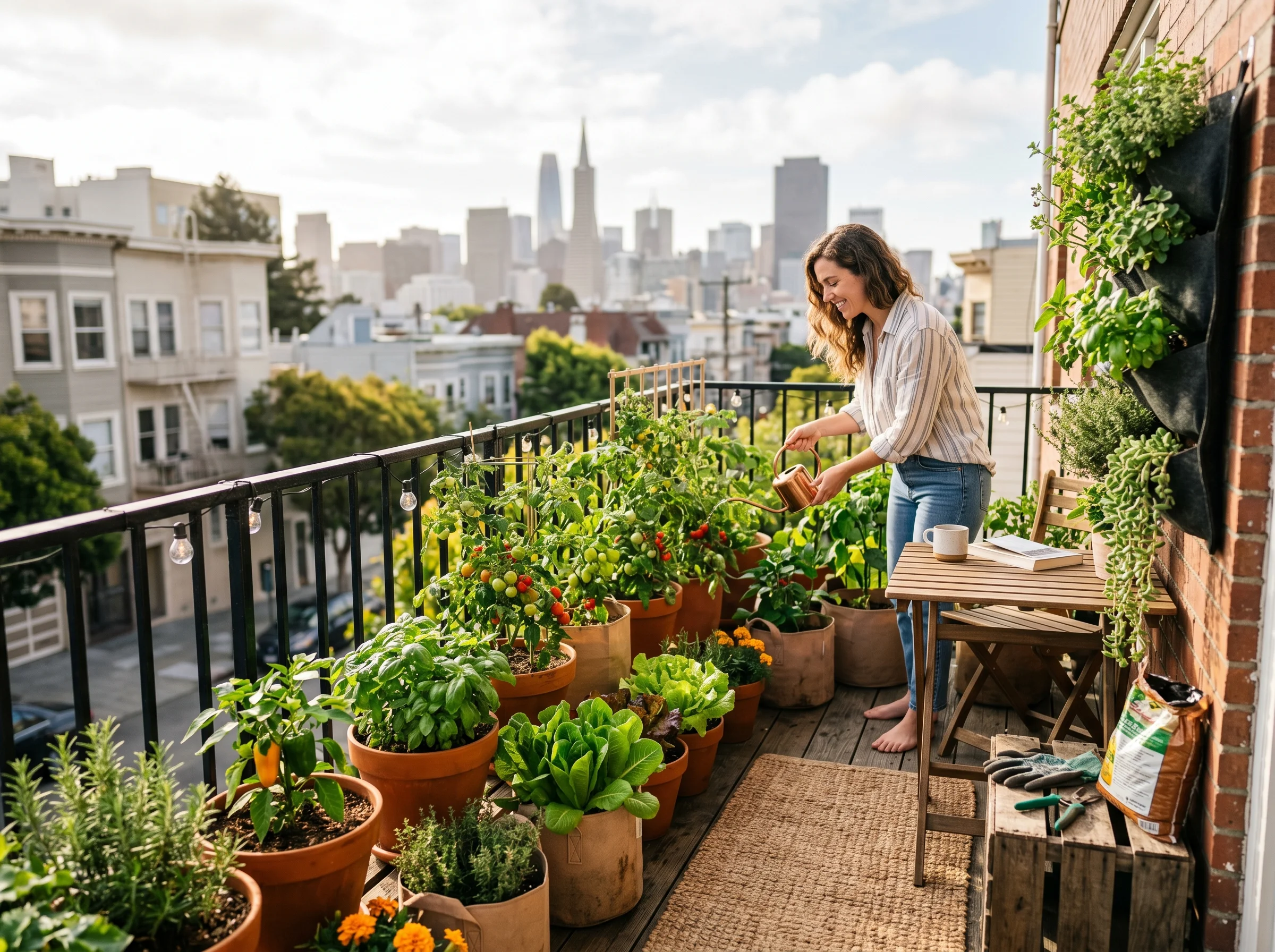
| 🟢 QUICK ANSWER BOX Small space gardening lets you grow fresh vegetables, herbs, and fruit in any limited outdoor or indoor area, balcony, patio, windowsill, or rooftop. The key is thinking vertically, choosing compact, high-yield crops, using the right containers or raised beds, and watering consistently. Even six square feet of a sunny space can produce meaningful food all season long. |
INTRODUCTION — YOU DON’T NEED A BACKYARD
You don’t need a backyard. You don’t need a half-acre lot, a farmhouse, or even a patch of actual ground. One sunny balcony corner — eight square feet of real estate — can produce fresh herbs, lettuce, cherry tomatoes, and peppers all season long.
I know because I’ve done it. My first productive garden was a 6-foot apartment balcony in a city that gets 200 days of cloud cover a year. I grew tomatoes in fabric grow bags, basil in a window box, and microgreens on my kitchen counter. It wasn’t Instagram-perfect. It was, however, genuinely productive—and it completely changed how I thought about what food growing requires.
Small space gardening is one of the fastest-growing segments of American home gardening. According to the National Gardening Association, apartment and urban gardeners now represent over 46% of all new food gardeners in the United States. Rising grocery prices, an interest in sustainable gardening, and the simple satisfaction of growing your own food have pushed millions of Americans toward edible gardening in the smallest spaces they have.
Here’s what most beginner guides get wrong: they describe small-space growing as a compromise—a lesser version of “real” gardening. That’s completely backwards. Limited-space cultivation forces a level of intention, efficiency, and plant knowledge that large-garden growers often never develop. When every square foot produces food or doesn’t, you learn fast.
This ultimate guide to small space gardening for beginners covers everything you need to go from zero to a genuinely productive container vegetable garden—regardless of whether you have a balcony, a small backyard, a patio, or just a sunny windowsill.
This guide is built around three core principles: growing up (vertical growing systems), growing densely (intensive planting methods), and growing smarter (crop selection, system choice, and maintenance habits). Master these three ideas, and your space limitation becomes largely irrelevant.
Let’s build something productive.
CORE FOUNDATIONS: WHERE ARE YOU GROWING?
Before choosing seeds, containers, or systems, you need an honest assessment of the space you’re actually working with. This single step prevents 80% of first-season failures in small-space gardens.
Understanding Your Sunlight Availability
Sunlight is the most important and least negotiable factor in any edible garden. Before spending a dollar on soil or seeds, spend two days observing your space.
Fruiting crops—tomatoes, peppers, cucumbers, beans, and squash—need a minimum of 6 to 8 hours of direct sunlight daily. No amount of perfect soil, organic compost, or ideal containers compensates for insufficient light with these crops. If your space gets fewer than 6 hours, you’re growing leafy greens, herbs, and root vegetables, which is still genuinely valuable and productive.
Leafy crops—lettuce, spinach, kale, arugula, and most herbs — manage with 3 to 5 hours of direct light and actually benefit from afternoon shade in summer, which slows the bolting process.
How to do a sunlight audit: For two consecutive days, check your balcony, patio, or windowsill every two hours from 8 am to 6 pm. Note whether it’s in direct sun or shade at each check. At the end, count your direct sun hours. This tells you exactly which crops will succeed in your space—before you invest in anything.
Understanding Your Microclimate
Small urban spaces create unique microclimate conditions that large-garden guides never address—because they don’t face them.
Balconies above the third floor face significantly more wind exposure than ground-level spaces. Wind desiccates plants, breaks stems, and dries soil moisture two to three times faster than calm conditions. Installing a simple windbreak, a trellis panel, a fabric screen, or a row of larger container plants protects smaller, more delicate crops behind it.
Concrete and brick surfaces reflect heat. A south-facing balcony on a hot July afternoon can generate temperatures 10 to 15 degrees Fahrenheit higher than ambient air temperature, stressing root systems in dark-colored containers. Light-colored pots and self-watering planters with moisture reservoirs buffer this heat stress significantly.
Rooftop gardens face the most extreme version of both challenges, maximum wind exposure and maximum heat reflection. They also require a structural weight assessment before any serious setup.
Structural Weight and Safety
This is the consideration most beginner guides skip entirely—and it matters.
Most residential balconies in the United States are rated for 40 to 60 pounds per square foot of load. A large, fully water-saturated raised garden bed can weigh 100 to 150 pounds or more. Before placing any heavy growing system on a balcony or rooftop, verify the load rating with your building’s management or a structural engineer.
For most balcony setups, fabric grow bags, lightweight plastic containers, and window boxes are the appropriate choice, not heavy wooden raised beds. Weight matters. It’s not worth the risk of ignoring it.
THE THREE MAIN GROWING SYSTEMS
Small space gardening is organized into three distinct systems, each suited to different living situations, budgets, and growing goals. Understanding which one fits your circumstances is your most important early decision.
Balcony and Deck Gardening
Balcony vegetable gardening is the most common form of urban gardening in America — and for good reason. A standard 6-by-10-foot apartment balcony offers enough growing space for a meaningful food garden when set up thoughtfully.
The challenges are specific: wind exposure at height, reflected heat from concrete walls and floors, structural weight limitations, and typically no access to in-ground soil. The solutions are equally specific: fabric grow bags for lightweight portability, vertical planters mounted on railings rather than floor space, and self-watering systems that buffer moisture loss from wind and heat.
The balcony garden setup rewards investment in verticality above anything else. A railing-mounted planter, a wall-hung pocket organizer, and two or three floor-level grow bags use the same footprint as a single large pot but produce four to six times more food.
→ For the complete balcony setup guide, read: [How to Grow Vegetables in Containers on a Balcony]
Small Backyards and Patio Gardening
A small backyard or patio is the most versatile small-space gardening environment available. You have ground contact, no structural weight concerns, and usually reasonable wind protection from fencing or buildings.
The opportunity here is replacing traditional row-style gardening — which wastes enormous amounts of space on walking paths — with compact gardening systems like raised beds, square foot gardening layouts, and intensive planting grids. A single 4-by-8-foot raised garden bed managed with intensive spacing produces more food than a 10-by-10-foot conventional row garden.
Raised beds are the single best investment for small backyards and patio spaces. They solve poor native soil problems, define growing areas clearly, and create the well-draining conditions that most container plants thrive in.
→ For a complete step-by-step setup, read: [How to Build a Raised Garden Bed for Small Yards]
Indoor Food Gardening
Indoor edible plants represent the most accessible entry point into home food production — no outdoor space required at all. A sunny south or east-facing window supports a productive herb garden year-round. A kitchen counter with a grow light can produce microgreens and salad greens regardless of season or outdoor conditions.
The indoor approach demands the most honest assessment of available light. Most indoor environments simply don’t provide the 6 to 8 hours of bright sunlight that fruiting crops need. The practical focus for indoor gardens is herbs, microgreens, lettuce, and baby greens—all of which produce meaningful kitchen harvests from genuinely limited indoor light.
→ For the complete indoor herb growing guide, read: [How to Grow Herbs on a Windowsill (No Yard Needed)]
GROW BAGS VS RAISED BEDS: CHOOSING YOUR SETUP

The most common question from beginners setting up their first small-space garden is whether to use fabric grow bags or build a raised garden bed. Both are excellent systems. The right choice depends on your specific situation—budget, mobility, permanence, and space.
Here is an honest, practical comparison of both systems:
| Growing System | Best Used For | Pros | Cons |
|---|---|---|---|
| Fabric Grow Bags | Balconies, patios, rentals, temporary setups | Excellent drainage, lightweight, portable, very affordable, air-prune roots for healthier plants | Dry out quickly in heat and wind, less insulation for roots, shorter lifespan (3–5 seasons) |
| Cedar Raised Garden Bed | Small permanent yards, patios, ground-level setups | Long-lasting (10–15 years), deeper soil volume, better moisture retention, looks beautiful | Higher upfront cost, heavy when filled, not portable, requires assembly |
| Plastic/Resin Containers | Any space, all budgets | Very durable, available in all sizes, retains moisture better than fabric | Can overheat in direct sun, drainage holes needed, less root aeration |
| Window Boxes | Balcony railings, windowsills | Space-efficient, lightweight, railing-mountable | Shallow depth limits to herbs and lettuce; dries quickly |
| Self-Watering Planters | Busy schedules, hot climates, balconies | A built-in water reservoir reduces watering frequency by 50%+, which is great for heat | Higher cost than basic pots, needs initial setup |
The practical recommendation for most apartment and balcony gardeners: start with two or three 5-gallon or 10-gallon fabric grow bags for tomatoes and peppers, add a railing-mounted window box for herbs, and use a shallow self-watering planter for lettuce and greens. That setup covers most beginner growing goals within a modest budget.
For anyone with a small backyard or permanent patio space: a single 4-by-4-foot or 4-by-8-foot cedar raised garden bed will outperform any collection of individual containers over a multi-year growing investment.
→ For a detailed breakdown of both systems with specific product recommendations, read: [Grow Bags vs Raised Beds: Which Is Better?]
VERTICAL GARDENING: GROWING UP, NOT OUT

The single most impactful concept in all of small space gardening is this: your growing space is not limited to your floor area. It extends as far upward as you can support plants.
A traditional garden uses only the ground plane. A vertical garden uses the ground plane, the wall plane, and the overhead plane simultaneously—tripling or quadrupling the productive space available within the same footprint.
This isn’t just theoretical efficiency. A 4-foot-wide trellis panel mounted against a wall and planted with climbing beans, cucumbers, or peas produces the same yield as a 4-by-6-foot ground-level bed—using zero additional floor space.
Why Traditional Gardening Wastes Space
Conventional row gardening was designed for large-scale agricultural efficiency — tractors, mechanized harvest, and uniform spacing for equipment access. It is profoundly inappropriate for small-space home food production.
Wide walking rows between widely-spaced plants leave more bare soil than growing soil in most traditional garden layouts. The walking paths alone in a standard 10-by-10-foot garden often consume 40 to 50 percent of the total space. In a small garden, you cannot afford this waste.
Growing Up Instead of Out
The vertical planter is your most space-efficient investment in any small garden. Options include:
Wall-mounted pocket planters for herbs, lettuce, and strawberries—they attach to fences, walls, or balcony railings and hold 12 to 24 individual plants in the space a single large pot occupies.
Freestanding trellises for climbing crops—cucumbers, pole beans, peas, small-fruited squash, and indeterminate tomatoes—all climb naturally when given vertical support. A 4-foot trellis turns a 1-square-foot floor footprint into 16 to 20 square feet of growing surface.
Railing planters that hang over balcony railings use exterior space completely unavailable to floor-mounted containers — effectively extending your growing area beyond your balcony’s physical footprint.
Hanging baskets for trailing crops like cherry tomatoes, strawberries, and trailing herbs use the overhead plane entirely.
Best crops for vertical growing systems: pole beans, cucumbers, sugar snap peas, indeterminate cherry tomatoes, climbing nasturtiums, and small melons with fruit support hammocks. All of these climb naturally with minimal guidance and produce prolifically per vertical foot of growing surface.
→ For a complete vertical setup guide with product recommendations and crop-specific trellis advice, read: [Vertical Gardening 101: How to Grow Up, Not Out]
SQUARE FOOT GARDENING: MAXIMUM DENSITY
Square-foot gardening is a specific intensive planting method developed by Mel Bartholomew in the 1970s and refined into one of the most practical small-space food growing systems available to home gardeners.
The core idea is elegant: instead of planting in rows with generous spacing between plants, you divide your raised bed or container into one-foot squares and plant each square with the maximum number of plants that can grow to maturity without crowding. A single 4-by-4-foot raised bed managed with square foot gardening principles can produce the equivalent output of a traditional 16-by-16-foot conventional row garden.
The basics of square foot gardening work like this: each one-foot square is assigned a crop and a planting density based on the plant’s mature size. Large plants like tomatoes and peppers get one plant per square. Medium plants like lettuce, spinach, and Swiss chard get four per square. Small plants like radishes and onions get 9 to 16 per square. Tiny plants like carrots and beets get 16 per square.
This intensive spacing maximizes harvests, minimizes bare soil (which reduces weeding), and creates a dense plant canopy that naturally shades and cools the soil beneath it—reducing soil moisture loss and moderating root zone temperatures.
The square foot method pairs exceptionally well with raised beds because the defined growing frame naturally creates the grid layout the system uses. It’s also the most beginner-accessible intensive planting method available—the rules are clear, the math is simple, and the results are dramatically better than guesswork spacing from seed packets designed for row gardens.
→ For a complete square foot gardening layout guide with printable planting grids, read: [Square Foot Gardening: Maximize Every Inch]
CROP SELECTION: THE “WORTH YOUR REAL ESTATE” RULE
Not every vegetable deserves space in a small garden. This is the crop selection rule that experienced small space gardeners developed by season two, and this guide will save you from learning the hard way.
The “worth your real estate” rule asks one question before planting anything: What is this crop’s yield per square foot relative to its growing time? Crops that take up enormous space for months and produce a single harvest are poor small-space choices. Crops that produce continuously over a long season from a compact footprint are excellent small-space choices.
Crops that waste valuable small-space real estate: Corn (needs large blocks for pollination, produces one ear per stalk, takes an entire growing season). Pumpkins and winter squash (sprawling vines that cover 20 to 30 square feet per plant for one or two fruit). Cabbages and Brussels sprouts (large plants, months to harvest, single yield). Watermelons (enormous space requirements for a single fruit that can be purchased inexpensively).
Crops that deliver exceptional small-space value: Herbs (continuous harvest from tiny space, extremely high retail value). Cherry tomatoes (enormous yield from one or two containers over an entire season). Lettuce and salad greens (cut-and-come-again harvesting from very shallow containers; regrows after cutting). Pole beans (high yield per square foot when grown vertically). Radishes (25-day harvest cycle, can be succession-planted continuously in the same small space all season).
Understanding Compact Cultivars
The modern seed catalog has transformed small-space growing over the past two decades. Plant breeders have developed compact, determinate, and dwarf varieties of almost every common vegetable specifically for container vegetable production and limited-space cultivation.
Key seed packet terms to understand:
“Determinate” tomatoes grow to a fixed height (typically 2 to 4 feet) and set all their fruit within a defined period — ideal for containers and small spaces. “Indeterminate” tomatoes grow continuously and can reach 6 to 8 feet or more, requiring substantial vertical support but producing all season.
“Bush variety” means the plant has a compact, mounded growth habit rather than sprawling vines. Bush cucumbers, bush beans, and bush squash all work well in containers.
Patio or dwarf varieties are specifically bred for container growing—smaller in every dimension while retaining full flavor characteristics.
“Compact cultivar” is a general term indicating the plant has been selected for reduced size without sacrificing productivity.
→ For a curated list of the highest-yielding crops for small gardens, read: [10 Best Vegetables to Grow in Small Spaces]
→ For specific variety recommendations by crop, read: [Best Compact Vegetable Varieties for Small Gardens]
HIGH-VALUE BEGINNER CROPS FOR SMALL SPACES

With crop selection principles established, these are the specific crops that deliver the best results for beginners in small-space growing systems based on yield per square foot, ease of care, and genuine practical value in a home kitchen.
Growing Tomatoes in Containers
Cherry tomatoes are the single best crop for beginner container vegetable production. One properly cared-for plant in a 5-gallon grow bag produces hundreds of tomatoes over a full growing season — a yield that would cost $40 to $60 to purchase organically at retail.
Container size matters more than most beginners realize. Tomatoes need a minimum of 5 gallons of soil volume for bush/determinate varieties and 10 gallons or more for indeterminate climbing types. Undersized containers restrict root development and create permanent moisture and nutrient stress that caps yield at a fraction of the plant’s true potential.
The most common patio tomato mistakes: using too-small containers, not providing adequate vertical support for indeterminate varieties, inconsistent watering that causes blossom end rot, and underfeeding containers, which need regular organic fertilizer because nutrients wash out of well-draining potting soil with every watering.
Varieties that consistently perform well in container situations: Tumbling Tom (trailing, ideal for hanging baskets); Patio (compact, determinate, proven container variety); Sungold (indeterminate cherry, exceptional flavor, very productive); and Bush Early Girl (compact, early-maturing, reliable).
→ For complete container tomato growing guidance, read: [How to Grow Tomatoes in Pots on a Patio]
Growing Microgreens Indoors
Microgreens deserve a place in every small-space gardening setup — even the smallest apartment with no outdoor space whatsoever. They’re the fastest indoor crop available (harvestable in 7 to 14 days), require only a shallow tray and a bright window or simple LED grow light, and produce some of the most nutritionally dense food per square inch of growing space of any crop.
The practical setup is a 10-by-20-inch seed tray filled with one inch of potting soil or coconut coir, seeded densely with your chosen microgreen variety, and placed in the brightest available indoor light. Sunflower, pea shoot, radish, and broccoli microgreens are among the easiest for beginners and produce the most abundant harvests.
Indoor lighting basics for microgreens: A south-facing window provides enough light for most varieties. If your window light is limited, a basic LED grow light panel suspended 4 to 6 inches above the trays is an affordable and highly effective alternative.
→ For a step-by-step microgreen growing guide, read: [How to Grow Microgreens at Home (No Garden Needed)]
Growing Herbs: Your Highest-Value Crop
No crop delivers better value per square foot in a small garden than fresh herbs. A 4-inch pot of basil from a grocery store costs $3 to $5 and lasts two weeks. The same pot of basil grown at home costs $0.50 in seeds and produces all season with regular harvest.
Herbs also function as excellent companion plants throughout your small garden—basil near tomatoes, dill near beans, marigolds near everything—attracting pollinators and deterring common pests without any chemical inputs.
The windowsill herb garden is the most accessible entry point into all of small-space gardening. A south-facing kitchen windowsill with three 4-inch pots of basil, parsley, and chives is a productive herb garden that takes 15 minutes to set up and requires almost nothing to maintain.
→ For a complete windowsill herb setup guide, read: [How to Grow Herbs on a Windowsill (No Yard Needed)]
WATERING & MAINTENANCE REALITIES

The biggest practical challenge in small space gardening isn’t sunlight, soil, or crop selection. It’s moisture management. Container plants and raised beds dry out significantly faster than in-ground gardens—sometimes requiring watering twice daily in peak summer heat—and inconsistent moisture is the primary cause of preventable crop failure in small-space systems.
The Moisture Problem
Containers and raised garden beds lose water through three mechanisms simultaneously: evaporation from the soil surface, transpiration through plant leaves, and drainage through the bottom of the container. In wind-exposed balcony situations, evaporation and transpiration rates increase substantially.
A 5-gallon grow bag in direct summer sun on a wind- exposed balcony can need water every 24 to 48 hours. A raised bed in a sheltered backyard might need water only twice a week in similar temperatures. Knowing your specific situation—and adjusting your watering schedule accordingly—is more valuable than any general rule.
The soil moisture check is your most important daily habit. Push your finger two inches into the potting soil. If it’s still moist at that depth, wait. If it’s dry, water thoroughly until water drains from the bottom of the container. Never water on a fixed schedule; water according to soil conditions.
Smart Watering Solutions
Self-watering planters with built-in water reservoirs are the single most impactful upgrade for balcony and patio small-space gardens. The reservoir system delivers water to roots from below through capillary action, consistently maintaining optimal soil moisture without daily intervention. Plants grown in self-watering systems in hot, dry conditions consistently outperform the same plants in conventional containers.
Drip irrigation systems for raised beds and larger container setups are worth the modest investment for anyone growing more than five or six containers. A basic timer-controlled drip line eliminates the watering variability that causes inconsistent growth and prevents the missed-watering events that stress plants during critical fruiting periods.
Mulching containers by applying a half-inch layer of organic compost or coco coir across the soil surface of your containers reduces evaporation by 40 to 60 percent. It’s the lowest-cost, highest-impact moisture retention technique available.
| Watering Problem | Main Cause | Best Solution |
|---|---|---|
| Soil drying too fast | Wind exposure + small container | Self-watering planter + mulch top layer |
| Root stress from heat | Dark containers in direct sun | Light-colored pots + larger container size |
| Uneven moisture in bed | Wind-driven uneven evaporation | Drip irrigation + heavy mulch layer |
| Nutrient washout | Frequent drainage flushes nutrients | Regular organic compost top-dress + liquid feed |
| Overwatering in cool weather | Same schedule year-round | Check soil moisture—reduce winter frequency |
The Nutrient Flush Factor
Every time water drains from a container or raised bed, it carries a small amount of dissolved nutrients with it. Over a full growing season, this nutrient flushing effect depletes even high-quality potting soil significantly, which is why container-grown plants need regular feeding that in-ground gardens don’t.
The most effective approach for small-space organic growers: apply a slow-release organic fertilizer at planting time (worked into the potting soil), supplement with diluted liquid organic fertilizer every two to three weeks during the active growing season, and top-dress containers with a thin layer of organic compost monthly.
Compost tea — compost steeped in water overnight and strained — is an excellent and inexpensive liquid fertilizer for container gardens. It reintroduces beneficial soil microorganisms that improve nutrient availability and root health in the enclosed container environment.
→ For specific product recommendations on self-watering systems for balconies, read: [Best Self-Watering Planters for Balconies: Top 7]
ESSENTIAL TOOLS FOR SMALL SPACE GARDENING
Small space gardening doesn’t require a garage full of equipment. The tool list is genuinely minimal — and most beginners already own some of what they need.
| Tool | Purpose | Pros | Cons | Approx. Cost |
|---|---|---|---|---|
| Hand Trowel | Planting, transplanting, mixing soil | Affordable, essential for all containers | Cheap models bend in dense potting soil | $12–$25 |
| Watering Can (1–2 gal) | Precise watering of containers and seedlings | Better control than hose for delicate plants | Slow for large setups—use drip for 6+ containers | $15–$30 |
| Bypass Pruners | Harvesting, trimming, training plants | Clean cuts that heal faster than tearing | Needs periodic sharpening to stay effective | $20–$40 |
| Spray Bottle | Misting seedlings, foliar feeding | Precise, gentle application | Not for large-scale watering | $5–$10 |
| Trellis Clips / Plant Ties | Training vertical crops to trellis | Gentle, reusable, prevents stem damage | Need to monitor and adjust as plant grows | $8–$15 |
| Soil Moisture Meter | Checking container moisture accurately | Eliminates guesswork, prevents over/underwatering | Cheap models can be inaccurate—buy mid-range | $15–$30 |
| Grow Light (LED) | Indoor herbs, microgreens, seedlings | Extends growing season, works year-round indoors | Electricity cost, requires setup | $30–$80 |
The honest minimum for your first season: a quality hand trowel, a watering can, and a pair of bypass pruners. Everything else can be added as your garden grows and your specific needs become clear.
COMMON MISTAKES BEGINNERS MAKE
These are the six mistakes I see most often from beginners in small-space setups — and the ones that cause the most preventable frustration.
Overcrowding Plants
The instinct to fill every inch of available container space with seedlings is understandable but counterproductive. Crowded plants compete for water, nutrients, light, and airflow. Poor airflow between crowded plants creates humid microclimates where fungal diseases thrive. Follow the spacing on your seed packets, even when the seedlings look tiny, and the space feels wastefully empty. They grow.
Underestimating Sunlight Needs
Buying tomatoes or peppers for a north-facing balcony that gets three hours of morning light is the most common cause of first-season disappointment. Sunlight requirements are not negotiable for fruiting crops. If your space doesn’t support tomatoes, grow lettuce beautifully instead of growing sad tomatoes badly.
Using Containers That Are Too Small
Under-sizing containers is the second most common mistake after incorrect sunlight assessment. Tomatoes in a 1-gallon pot, peppers in a 2-inch cell, or herbs in a tiny decorative pot without drainage—all will produce a fraction of their potential and require constant stress management. Always size up when in doubt. A bigger container is almost always better.
Forgetting Vertical Support
Indeterminate tomatoes, climbing beans, and cucumbers planted without trellis support become unmanageable within weeks. The time to install a trellis is at planting—not after the plant is already sprawling and tangled. Get the support structure in place before the plant needs it.
Inconsistent Watering
Missing watering sessions during fruit development causes blossom end rot in tomatoes, bitter cucumbers, and cracked tomato fruit. In containers, the consequences of missed watering arrive faster and more severely than in in-ground gardens. During peak summer heat, some containers need water every single day. Plan accordingly.
Ignoring Drainage Holes
Containers without drainage holes create waterlogged conditions that cause root rot within days during hot weather. Every container must have drainage holes. Beautiful decorative cache pots without holes are used as outer sleeves around nursery pots that have drainage — never as the planting container directly.
SEASONAL TIPS FOR SMALL SPACE GARDENS
Summer Balcony Heat Protection
Move heat-sensitive crops—lettuce, spinach, and herbs—to shadier spots on the balcony during peak summer weeks. Install shade cloth (30 to 50 percent density) over the most exposed containers during the hottest part of the day. Water in the early morning before the heat builds. Refresh mulch across all container tops.
Winter Container Care
In USDA zones 5 and colder, containers left outdoors through winter freeze and thaw cycles can crack. Either bring containers indoors, empty and store them upside-down, or insulate them with burlap wrapping. Move overwintering herbs to the brightest available indoor window or supplement with a simple LED grow light during the short winter daylight hours.
Rainy Season Drainage Management
Extended wet periods in spring or fall create overwatering risk even for containers with drainage holes. Elevate containers slightly on pot feet or blocks to ensure active drainage rather than pooling at the base. Check soil moisture before watering, even when rain has fallen—containers under balcony overhangs often stay dry even during rain events.
Wind Protection for Rooftop Gardens
Rooftop and high-rise balcony gardens benefit from a dedicated windbreak solution. A trellis panel, a fabric wind screen, or a row of larger container plants on the windward side of the garden protects smaller, more vulnerable crops from desiccation and stem damage. Secure all containers, trellises, and lightweight planters against tipping in high winds—especially important during summer storm season in most US regions.
FREQUENTLY ASKED QUESTIONS
What is the easiest vegetable for small spaces?
Lettuce and salad greens are the easiest vegetables for small-space and beginner growing. They grow quickly (30 to 45 days), need only 4 to 6 inches of soil depth, tolerate partial shade, and can be harvested continuously throughout the season by taking outer leaves rather than pulling the whole plant. Cherry tomatoes are the most rewarding beginner crop once you have a sunny spot — but they require more attention than leafy greens.
Can you grow enough food in containers to matter?
Yes — with realistic expectations. A well-managed balcony garden of six to eight containers can realistically provide most of your fresh herb needs, significant salad greens, cherry tomatoes through summer, and peppers through fall. You won’t replace a weekly grocery run, but you will meaningfully reduce your fresh produce spending and eliminate the produce items that cost most at retail — organic herbs, specialty greens, and cherry tomatoes specifically.
Are grow bags better than pots?
For balcony vegetable gardening and portable setups, fabric grow bags offer genuine advantages: better root aeration (roots air-prune at the bag’s edges, creating a denser, more fibrous root structure), superior drainage, lighter weight, and lower cost. For long-term permanent setups, traditional containers or cedar raised beds outperform grow bags in moisture retention and lifespan. The best answer depends entirely on your specific situation.
How much sunlight do balcony vegetables need?
Fruiting vegetables—tomatoes, peppers, cucumbers, beans — need 6 to 8 hours of direct sunlight per day. Leafy vegetables and herbs—lettuce, spinach, kale, basil, and parsley — need 3 to 5 hours and tolerate partial shade. Root vegetables like radishes and beets fall in the middle, performing well with 4 to 6 hours. Assess your actual available sunlight before choosing crops, not after.
What vegetables grow best indoors?
The best indoor edible plants are microgreens (any bright space), herbs (bright windowsill or grow light), lettuce and baby greens (south-facing window or LED), and green onions (water glass on a windowsill—regrow from grocery store roots). Without supplemental grow lighting, fruiting crops like tomatoes and peppers do not produce meaningfully indoors in most home environments.
CONCLUSION
The most important mindset shift in small space gardening is this: your constraints are an advantage in disguise.
Small gardens teach plant care faster than large ones because every plant receives closer, more consistent attention. You notice the first sign of stress earlier. You learn the difference between overwatered and underwatered leaves faster. You understand sunlight requirements more precisely because your plants teach you with immediate, observable feedback.
Even one square foot of growing space can produce fresh food. A single window box of herbs changes how you cook. One container of cherry tomatoes changes how you think about what home food production requires.
Space-saving gardening isn’t a compromise version of “real” gardening. It’s an intentional, efficient, deeply satisfying practice that millions of Americans are building into their daily lives right now—in apartments, on rooftops, and in 6-by-10-foot balcony spaces that nobody thought could grow anything worth eating.
Choose one growing system from the guides linked below. Commit to growing one edible plant this weekend. A single container of herbs or a grow bag of cherry tomatoes is enough to begin building a productive small-space food garden that grows in scope and confidence with every season.
The best time to start was last spring. The second-best time is right now.