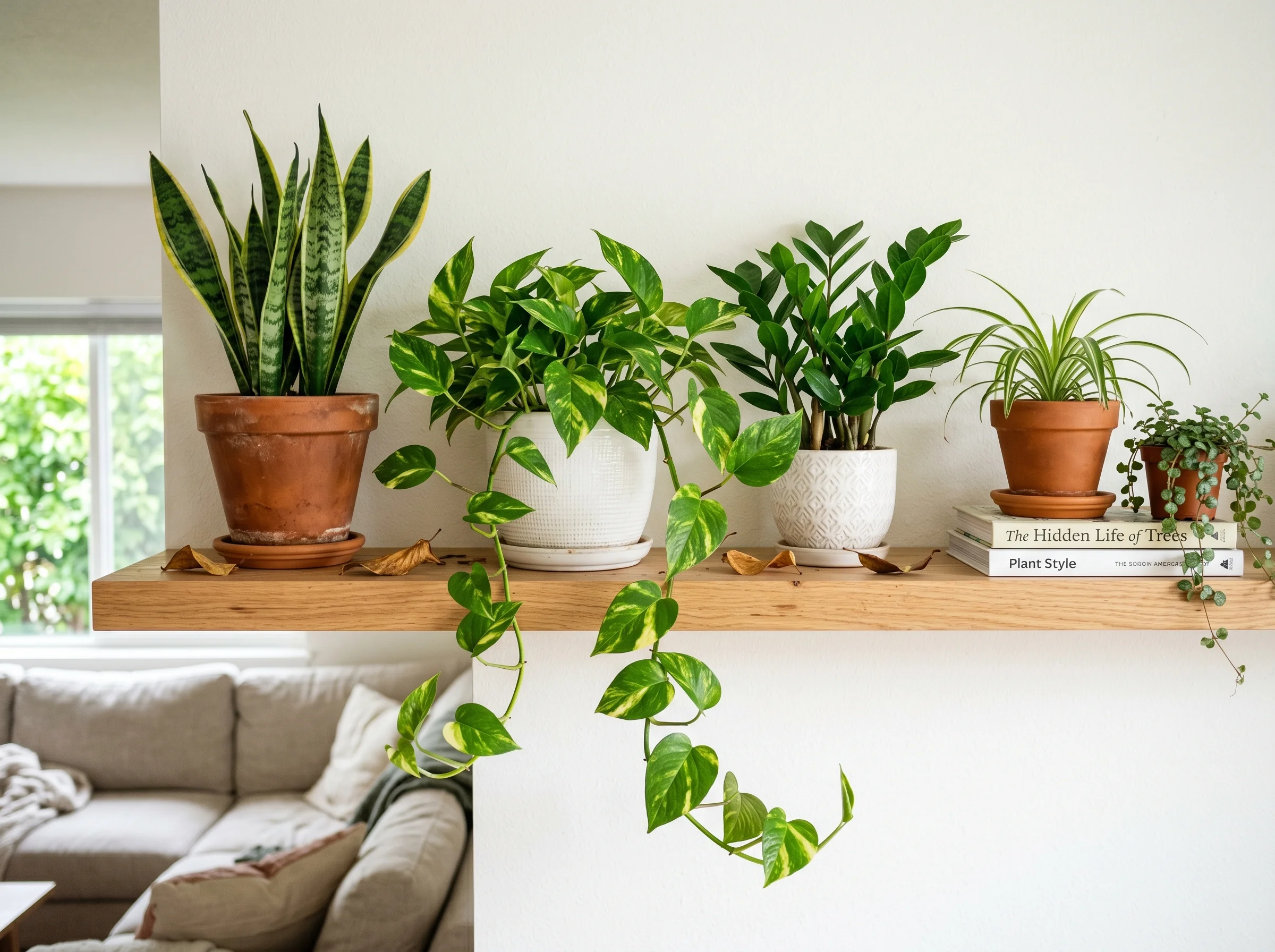
| 🟢 QUICK ANSWER BOX Most beginners don’t kill houseplants because they lack a green thumb. They kill them because they start with the wrong plants. The best houseplants for beginners survive irregular watering, tolerate low light, and bounce back from neglect. Top picks: Snake Plant, Pothos, ZZ Plant, Spider Plant, and Aloe Vera all thrive with minimal care and forgive the mistakes every beginner makes. |
Introduction—Why Most Beginners Kill Plants
Most people don’t kill houseplants because they’re careless. They kill them because they start with the wrong plants.
I learned this the hard way. My first plant was a fiddle leaf fig—beautiful, trendy, and one of the most demanding houseplants you can possibly own. It dropped leaves within two weeks. I blamed myself. I thought I was simply bad with plants and avoided buying any for almost a year.
Then someone gave me a small Snake Plant in a chipped terracotta pot. I watered it when I remembered, which honestly wasn’t that often. I moved it around my apartment. I did almost everything wrong. Six months later, it was thriving, putting out new leaves, and looking genuinely beautiful in my living room.
That’s when I realized it wasn’t me. It was the plant selection.
If you’ve ever bought a houseplant full of optimism only to watch it wilt and die within weeks, this guide was written for you. I’ve spent years testing, growing, and occasionally killing houseplants so I could give you an honest list of the best houseplants for beginners that actually survive real-life conditions.
Not Instagram-perfect conditions. Real conditions. A busy schedule, an apartment with limited light, and a pet that investigates everything new. These 15 plants handle all of that.
What Makes a Houseplant Beginner-Friendly?
Before we get to the list, it’s worth understanding what actually separates an easy plant from a difficult one—because this knowledge changes how you shop forever.
Forgiving Watering Needs
The number one killer of houseplants is overwatering—not underwatering. The best beginner plants either store water in their leaves, like succulents and Aloe Vera, go long periods between waterings without stress, like ZZ plants, or recover quickly from both overwatering and underwatering, like pothos. If a plant needs a precise watering schedule to survive, it is not a beginner plant.
Low-Light Tolerance
Most homes and apartments don’t have the bright, consistent indirect sunlight that more demanding tropical plants require. Beginner-friendly plants have adapted to low-light conditions over thousands of years in naturally shaded forest environments—and they bring that adaptability to your dim corner or north-facing window.
Drought Tolerance and Adaptability
A plant that survives a week without water survives a busy week, a work trip, or simply forgetting. Drought-tolerant houseplants give beginners the margin for error they need while building confidence and developing their plant care instincts over time.
The best low-maintenance indoor plants don’t dramatically react to every small change in temperature, humidity, or light. They settle into your home’s specific conditions and stay there, consistently and quietly.
One important note before we continue: hard to kill does not mean impossible to kill. Every plant on this list has limits. But those limits are far more forgiving than most houseplants—and understanding that honestly will help you grow with more confidence and significantly less guilt.
The 15 Best Houseplants for Beginners
These are the easiest houseplants to grow, ranked by how forgiving they are of the mistakes beginners most commonly make. Each entry covers what you’ll love about it, what it truly needs, the single biggest beginner mistake with that specific plant, and its pet safety status.

1. Snake Plant (Sansevieria / Dracaena trifasciata)
If I could give every plant beginner exactly one plant to start with, it would be the Snake Plant. No other common houseplant is this tolerant of neglect, this adaptable to different light conditions, and this reliably beautiful year after year.
Snake Plants grow in upright, sword-like leaves with striking yellow-edged or silver-patterned variegation. They look architectural—genuinely elegant in any room—and they ask almost nothing in return.
Light: Adapts to almost any indoor light, from low light conditions to bright indirect light. Avoid only prolonged, harsh direct sun, which can scorch the leaves.
Watering: Every 2–6 weeks, depending on the season. In winter, once a month is often sufficient. Always check soil moisture at 2 inches depth before watering. Let the soil dry out completely between waterings.
Biggest beginner mistake: Overwatering. Snake Plants store water in their thick leaves and rhizomes. Wet soil sitting against roots causes root rot faster than almost anything else. When in doubt—wait another week.
Best placement: Bedroom (they convert CO₂ to oxygen at night—one of the better air purification plants for sleeping spaces), office desk, or any dim corner that needs a vertical architectural statement.
Pet safety: ⚠️ Mildly toxic to cats and dogs if ingested. Keep out of reach of curious pets.
→ Want the complete Snake Plant care guide? [Snake Plant Care: World’s Toughest Houseplant]
2. Pothos (Epipremnum aureum)
Pothos is the plant that convinced an entire generation of apartment dwellers that they could keep plants alive, and for excellent reason. It’s nearly impossible to kill through normal neglect; it grows visibly and quickly (which feels deeply rewarding as a beginner), and it adapts to an extraordinary range of indoor conditions.
The Golden Pothos is the most common variety, with heart-shaped leaves in bright green with gold marbling. Marble Queen (cream and green), Neon Pothos (electric lime green), and Manjula (ruffled, variegated) all offer the same bulletproof nature with beautifully different visual aesthetics.
Light: Genuinely tolerates low light conditions — one of the best easy indoor plants for dim rooms or apartments with limited natural light. Variegated varieties maintain their color contrast better in brighter indirect sunlight.
Watering: Every 1–2 weeks in warmer months, every 2–3 weeks in winter. Pothos communicates clearly when it needs water; leaves develop a slight wrinkle or gentle droop. Water thoroughly when that happens.
Biggest beginner mistake: Letting it sit in water. Pothos needs drainage holes in its pot. Standing water leads to root rot and the gradual yellowing and collapse that beginners often attribute to “not enough water,” when the opposite is actually true.
Best placement: Hanging basket to show off its trailing growth, a high shelf, or trained up a moss pole. Propagates extremely easily in a glass of water — one of the best first propagation projects available.
Pet safety: ⚠️ Toxic to cats and dogs. Mild to moderate toxicity. Keep away from pets that chew plants.
→ For the complete Pothos care guide with variety profiles, troubleshooting, and propagation steps: [Pothos Care Guide: Easiest Houseplant for Beginners]
3. ZZ Plant (Zamioculcas zamiifolia)
The ZZ Plant has earned a devoted following among beginner plant parents because it thrives on benign neglect. It evolved in East African regions that experience extended dry seasons — meaning drought tolerance isn’t just a feature; it’s baked into the plant’s fundamental biology.
Glossy, deep green leaves on gracefully arching stems make it one of the most architecturally striking of all the beginner-friendly indoor plants. The Raven ZZ variety, which produces nearly black leaves, is one of the most visually dramatic houseplants available anywhere.
Light: One of the best hard to kill houseplants for genuinely dark rooms. Tolerates low light conditions better than almost any other common houseplant. Grows slowly in near-shade. Avoids only complete darkness.
Watering: Every 3–4 weeks in summer, every 4–6 weeks in winter. Thick rhizomes underground store water for extended periods, making this truly one of the best indoor plants for forgetful owners.
Biggest beginner mistake: Overwatering from guilt. The ZZ’s slow growth rate leads beginners to think it needs more water to speed up. It doesn’t. It simply grows slowly by nature. More water won’t change this — it will only cause root rot over time.
Best placement: Office, dim living room corner, or any space that needs reliable, beautiful greenery with genuinely zero drama.
Pet safety: ⚠️ Toxic to cats and dogs. Wash your hands after handling, as the sap can irritate skin.
→ For the full ZZ Plant care guide, including Raven ZZ variety details and troubleshooting: [ZZ Plant Care Guide: Most Indestructible Houseplant]
4. Spider Plant (Chlorophytum comosum)
Spider Plants are one of the most cheerful, resilient, and genuinely beginner-friendly houseplants available. They grow fast enough to feel rewarding, produce adorable babies (small plantlets on long runners) that you can propagate and share with friends, and thrive in conditions that would stress most other plants.
The long, arching green-and-white striped leaves look beautiful in hanging baskets. A mature Spider Plant with a dozen dangling babies is one of the most satisfying sights in any indoor plant collection.
Light: Prefers bright indirect light but adapts well to moderate and low light conditions. One of the better easy houseplants for beginners in north-facing rooms.
Watering: Every 1–2 weeks. More forgiving than most plants, it tolerates both slightly dry and slightly overwatered conditions without serious consequences.
Biggest beginner mistake: Using tap water with too much fluoride or chlorine, which causes brown leaf tips. If your tap water is heavily treated, let it sit overnight before using, or switch to filtered water.
Best placement: Hanging basket near a window, bathroom shelf (tolerates humidity beautifully), or any spot where the trailing babies can be fully appreciated.
Pet safety: ✅ Non-toxic to cats and dogs. One of the best pet-friendly houseplants available.
5. Peace Lily (Spathiphyllum wallisii)
The Peace Lily is the only plant on this list that actively communicates with you. When it needs water, it droops dramatically and clearly. Water it, and within hours it stands upright again, as if nothing happened. For beginners learning to read plant signals, this is enormously helpful.
Peace Lilies also produce elegant white flowers, thrive in low light conditions, and are among the most studied houseplants for indoor air purification. NASA’s Clean Air Study placed them in the top tier of air-cleaning indoor plants.
Light: One of the very best low-light indoor plants available. Flowers most abundantly in bright indirect light, but grows healthy and strong in genuinely dim indoor conditions.
Watering: Every 1–2 weeks. Water when the top inch of potting soil feels dry. The gentle drooping signal (before serious wilting) is your completely reliable visual cue.
Biggest beginner mistake: Panic-watering after neglect. When a Peace Lily droops dramatically, the instinct is to flood it. Water it once, thoroughly, then wait for full recovery before watering again. Repeated emergency watering without allowing drainage causes root rot.
Best placement: Low-light bathroom (loves humidity from showers), shaded bedroom, or dim home office.
Pet safety: ⚠️ Toxic to cats and dogs. It can cause significant mouth and throat irritation if ingested.
6. Aloe Vera (Aloe barbadensis miller)
Aloe Vera earns its place on any best plants for beginners list not just because it’s easy to grow, but because it’s genuinely useful to own. The clear gel inside the thick, fleshy leaves soothes minor burns, sunburns, and skin irritation—a living first-aid kit on your windowsill.
As a succulent, Aloe stores water in its leaves and has evolved to go weeks without rainfall. In your home, this translates to a plant that actively prefers neglect over excessive attention.
Light: Bright indirect light to some direct morning sun. A south- or east-facing window is ideal. Can handle a few hours of direct sun but will discolor in prolonged, harsh direct afternoon light.
Watering: Every 3–4 weeks in summer, every 6–8 weeks in winter. One of the most drought-tolerant houseplants available. Leaves feel firm when well-hydrated and slightly soft when genuinely thirsty.
Biggest beginner mistake: Keeping soil consistently moist. Aloe must have a well-draining cactus/succulent potting mix and drainage holes in the pot. Consistent moisture causes root rot very quickly.
Best placement: Kitchen windowsill for practical use, sunny bathroom, or bright bedroom window.
Pet safety: ⚠️ Toxic to cats and dogs if ingested internally.
7. Jade Plant (Crassula ovata)
Jade Plants are succulent shrubs with thick, woody stems and glossy oval leaves that store water for extended dry periods. They’re slow-growing and genuinely long-lived—some household specimens have survived for decades—and develop real character over time as their stems thicken and branch.
In many cultures, the Jade Plant is a symbol of good luck and prosperity. A lovely bonus from a plant that requires almost nothing from you.
Light: Bright indirect light with some morning direct sun. One of the best beginner-friendly indoor plants for sunny windowsills. Needs more consistent light than most plants on this list.
Watering: Every 2–3 weeks in spring and summer, monthly in winter. Feel the leaves; firm and plump means well-hydrated; slightly soft means it’s time to water.
Biggest beginner mistake: Planting in heavy, regular potting soil. Jade Plants need a well-draining succulent mix with added perlite to prevent root rot from sitting in moisture around the roots.
Best placement: Bright south or east-facing windowsill, a sunny home office desk, or a well-lit kitchen.
Pet safety: ⚠️ Toxic to cats and dogs.
8. Chinese Evergreen (Aglaonema commutatum)
Chinese Evergreens are one of the most underappreciated gems in the world of easy houseplants for beginners. They come in a remarkable color range, dark green, silver- patterned, pink-flushed, and red-veined, and all varieties share the same easygoing, low-maintenance nature.
They’re particularly valuable as low-light indoor plants. While most colorful houseplants need bright conditions to maintain their variegation, Chinese Evergreens in darker- colored varieties genuinely thrive in low light conditions that few other plants handle well.
Light: Dark green varieties tolerate low light very well. Pink and red varieties prefer brighter indirect sunlight. Both avoid direct sun. Very adaptable to typical apartment light conditions.
Watering: Every 1–2 weeks. Somewhat tolerant of infrequent watering but performs best when checked regularly and watered before complete drought stress.
Biggest beginner mistake: Cold drafts. Chinese Evergreens dislike cold temperatures from air conditioning vents or cold windows in winter. Keep above 60°F (15°C).
Best placement: Dim living room corners, bedrooms, shaded home offices, or any apartment room with limited natural light.
Pet safety: ⚠️ Toxic to cats and dogs.
9. Cast Iron Plant (Aspidistra elatior)
The name says everything. The Cast Iron Plant earned its common name through sheer, documented toughness. Victorian households kept them in dark hallways, in rooms lit only by gas lamps, in conditions that would kill virtually any other plant on this list.
It grows slowly. It rarely does anything dramatic. But it stays alive, reliably, year after year in conditions that represent some of the worst any indoor environment can offer. If you have a dark corner that has defeated every plant you’ve tried, this is your solution.
Light: Tolerates deep shade and low light conditions better than any other common houseplant. Avoid only prolonged, harsh direct sun, which burns the leaves.
Watering: Every 2–4 weeks. Extremely tolerant of irregular watering. Survives genuine neglect that would seriously damage most other houseplants.
Biggest beginner mistake: Expecting fast growth. The Cast Iron Plant grows very slowly—a few new leaves per year is completely normal. This is its nature, not a sign of poor care. Patience is the only real requirement.
Best placement: Dark hallway, north-facing room, shaded office corner, or any spot in your home where you’ve previously given up on plants succeeding.
Pet safety: ✅ Non-toxic to cats and dogs.
10. Rubber Plant (Ficus elastica)
Rubber Plants have had a significant resurgence in popularity, and deservedly so. The large, glossy leaves in deep green, burgundy, or variegated cream-and-green patterns make a genuine design statement. They grow into substantial indoor trees over several years, which feels genuinely rewarding to watch.
They’re more forgiving than other Ficus species (including the notoriously difficult fiddle leaf fig) and adapt reasonably well to typical apartment conditions with moderate, consistent care.
Light: Bright indirect light is ideal. Tolerates moderate light but grows more slowly and loses some of the rich leaf color depth. Avoid the low light conditions that work for Snake plants—rubber plants need more.
Watering: Every 1–2 weeks in the growing season, every 2–3 weeks in winter. Let the top 1–2 inches of soil dry between waterings. Wipe large leaves monthly with a damp cloth to remove dust that blocks light absorption.
Biggest beginner mistake: Overwatering combined with insufficient light. Rubber Plants in dim spots use water very slowly, meaning wet soil sits longer, and root rot risk increases significantly.
Best placement: Near a bright window but shielded from direct sun. Excellent as a floor plant in a bright living room or bedroom corner.
Pet safety: ⚠️ Mildly toxic to cats and dogs.
11. Heartleaf Philodendron (Philodendron hederaceum)
The Heartleaf Philodendron is frequently confused with Pothos; both trail beautifully, both tolerate low light conditions, and both are among the most forgiving easy indoor plants available. The key difference is leaf texture: Philodendron leaves are thinner, softer, and slightly velvety with a matte finish.
Where they differ most significantly: the Philodendron tolerates even lower light than the pothos and requires marginally more consistent moisture to stay at its best.
Light: Low to moderate indirect sunlight. One of the best indoor plants for apartments with limited natural light. Very adaptable across different rooms.
Watering: Every 1–2 weeks. Water when the top inch of potting soil feels dry. Yellowing lower leaves typically indicate overwatering; brown, crispy tips suggest underwatering or low humidity.
Biggest beginner mistake: Overwatering in low light. Like the Rubber Plant, Philodendrons in dim conditions use water more slowly. Adjust your watering schedule based on actual light levels, not a fixed weekly schedule.
Best placement: Shelf, hanging basket, or trained up a moss pole. Excellent in bathrooms with indirect light and natural ambient humidity.
Pet safety: ⚠️ Toxic to cats and dogs.
12. Parlor Palm (Chamaedorea elegans)
The Parlor Palm has been grown as a low-maintenance indoor plant since Victorian times—a track record that alone speaks to its remarkable adaptability. It’s one of the very few palms that genuinely thrives in low to moderate indoor light, making it perfect for adding a tropical plant feel to spaces that can’t support more light-demanding palms.
Graceful, arching fronds and a clean, elegant growth habit make it one of the most popular apartment plants for beginners looking for something that feels genuinely tropical without the demanding care requirements.
Light: Tolerates low light and indirect sunlight well. Grows faster in bright indirect light. Keep out of direct sun, which scorches the delicate fronds.
Watering: Every 1–2 weeks. Less drought-tolerant than succulents—prefers consistently moist (but not wet) soil. Let the top inch dry before rewatering.
Biggest beginner mistake: Letting it sit in standing water in the drainage saucer. Empty saucers after each watering, and ensure the pot has drainage holes.
Best placement: Bright but indirect living room corner, bedroom, or shaded home office. Beautiful as a floor plant once it reaches 2–3 feet tall.
Pet safety: ✅ Non-toxic to cats and dogs. One of the very best pet-friendly houseplants available.
13. Dracaena (Dracaena marginata / Dracaena fragrans)
Dracaena is one of the most popular easy houseplants for office environments—and that well-earned reputation has made its way into home collections for equally good reason. It tolerates low light, infrequent watering, air-conditioned environments, and general neglect without complaint.
The Corn Plant variety (Dracaena fragrans) has broad, corn-like leaves with yellow central stripes. The Dragon Tree variety (Dracaena marginata) has thin, spiky red-edged leaves on woody canes, which are dramatic and architectural. Both are equally beginner-friendly.
Light: Adapts well to low to moderate indirect light. Bright indirect light supports faster growth and stronger color variegation. Avoid direct sun.
Watering: Every 1–2 weeks in summer, every 2–3 weeks in winter. Like Spider Plants, Dracaena is sensitive to fluoride in tap water—brown leaf tips are a common symptom. Allow tap water to sit overnight or use filtered water if this is a recurring issue.
Biggest beginner mistake: Cold drafts and temperature fluctuations. Keep in a stable temperature above 60°F and away from air conditioning vents.
Best placement: Office desk, floor plant in a living room corner, or any medium-light indoor space that benefits from a vertical, dramatic plant form.
Pet safety: ⚠️ Toxic to cats and dogs.
14. Monstera Deliciosa (Swiss Cheese Plant)
Monstera Deliciosa is one of the most photographed houseplants in the world—and it’s also reasonably beginner-friendly once you understand what it actually needs, which is less than its dramatic presence suggests.
The large, glossy leaves with their distinctive natural holes (technically called fenestrations) are immediately recognizable. A healthy Monstera in a bright room is one of the most striking plants you can grow indoors, and it grows fast enough in good conditions that the weekly progress feels genuinely satisfying.
Light: Bright indirect light is ideal. Tolerates moderate indirect light but produces fewer fenestrations (the iconic holes) in the leaves as a result. Young plants develop fenestrations naturally as they mature in good light.
Watering: Every 1–2 weeks. Let the top 2 inches of potting soil dry before watering. Yellow patches on leaves typically signal overwatering — the most common beginner mistake with this plant.
Biggest beginner mistake: Placing it in a dark corner and wondering why leaves don’t develop holes. Fenestrations develop in response to consistent bright light. In low light, leaves emerge plain, and the plant grows much more slowly.
Best placement: A bright living room with a large east- or north-facing window, or as a dramatic floor plant in a well-lit bedroom. Needs a moss pole or sturdy support as it matures.
Pet safety: ⚠️ Toxic to cats and dogs.
→ For the complete Monstera care guide, including variety profiles, moss pole setup, and troubleshooting: [Monstera Plant Care: The Ultimate Statement Plant]
15. Haworthia (Haworthia fasciata / Haworthia attenuata)
Haworthia rounds out this list as the perfect plant for anyone wanting a small, sculptural, genuinely low- maintenance addition to a desk, windowsill, or shelf. It looks like a miniature aloe—rosette-shaped with striped or bumpy leaf texture—and is even more tolerant of typical indoor conditions.
Unlike most succulents that need strong direct light, Haworthia genuinely tolerates lower indoor light levels, making it one of the very few succulents that work realistically in typical home and office environments.
Light: Bright indirect light to moderate light. Tolerates lower light far better than Aloe Vera or Jade Plant. One of the best easy succulent options for indoor environments without strong direct sun.
Watering: Every 3–4 weeks in summer, every 5–6 weeks in winter. Drought-tolerant—prone to root rot from overwatering, exactly like all other succulents. Water deeply, then wait, fully and completely, for the soil to dry before the next watering.
Biggest beginner mistake: Overwatering in a low-light spot. Even Haworthia uses water very slowly when light levels are low. Reduce watering frequency accordingly.
Best placement: Desk, windowsill, bookshelf, or bathroom counter with some natural light. It stays small—rarely over 6 inches—making it ideal for spaces where larger plants simply don’t fit.
Pet safety: ✅ Non-toxic to cats and dogs. One of the safest succulent choices for pet owners
All 15 Plants — Quick Comparison Table
| Plant | Light Needs | Water Frequency | Pet Safe? | Best For |
|---|---|---|---|---|
| Snake Plant | Low–Bright Indirect | Every 2–6 wks | ⚠️ No | Neglect, dark corners |
| Pothos | Low–Bright Indirect | Every 1–2 wks | ⚠️ No | Trailing, shelves |
| ZZ Plant | Low–Moderate | Every 3–6 wks | ⚠️ No | Forgetful owners |
| Spider Plant | Low–Bright Indirect | Every 1–2 wks | ✅ Yes | Pets, propagation |
| Peace Lily | Low–Bright Indirect | Every 1–2 wks | ⚠️ No | Low-light rooms |
| Aloe Vera | Bright Indirect | Every 3–4 wks | ⚠️ No | Sunny windowsills |
| Jade Plant | Bright Indirect | Every 2–3 wks | ⚠️ No | Sunny spots |
| Chinese Evergreen | Low–Moderate | Every 1–2 wks | ⚠️ No | Dark apartments |
| Cast Iron Plant | Low–Moderate | Every 2–4 wks | ✅ Yes | Very dark spaces |
| Rubber Plant | Bright Indirect | Every 1–2 wks | ⚠️ No | Statement plant |
| Philodendron | Low–Moderate | Every 1–2 wks | ⚠️ No | Trailing, low light |
| Parlor Palm | Low–Bright Indirect | Every 1–2 wks | ✅ Yes | Tropical look |
| Dracaena | Low–Moderate | Every 1–2 wks | ⚠️ No | Office, tall spaces |
| Monstera | Bright Indirect | Every 1–2 wks | ⚠️ No | Statement, bright rooms |
| Haworthia | Low–Bright Indirect | Every 3–6 wks | ✅ Yes | Desks, small spaces |
Pet-safe options: Spider Plant, Cast Iron Plant, Parlor Palm, and Haworthia.
Common Beginner Houseplant Mistakes

Overwatering — The #1 Plant Killer
More houseplants die from overwatering than from any other single cause. The problem is that overwatering and underwatering can look almost identical: yellow leaves, wilting, and drooping. Beginners see those signs and water more, which accelerates the problem significantly.
The fix is simple and permanent: always check soil moisture before watering. Push your finger two inches into the potting soil. If it’s still moist at that depth, wait. Only water when the soil is genuinely dry.
For a complete guide to the most common causes of yellow houseplant leaves and exactly how to diagnose each one: → [Why Are My Houseplant Leaves Turning Yellow?]
For the complete beginner watering guide covering every common mistake and how to fix it: → [How to Water Houseplants Correctly (Biggest Mistake)]
No Drainage Holes
Pots without drainage holes trap water in the root zone. Even drought-tolerant plants can’t survive prolonged standing water around their roots. Root rot — a fungal condition caused by saturated soil — is fatal to most houseplants and develops faster than beginners expect.
Always use pots with drainage holes. Beautiful decorative cache pots work perfectly as outer sleeves; just always plant into a nursery pot with holes inside them.
Wrong Lighting Expectations
“Low light” on a plant label does mean no light. It means the plant tolerates lower light than most—typically the equivalent of a bright room without direct sun or a position 8–10 feet from a window. True darkness doesn’t support plant life in any meaningful way.
Honestly assess the light in the spot you have in mind before choosing a plant. Match the plant to the actual light available — not the light you wish you had.
Moving Plants Constantly
Plants need time to acclimate to their location. After bringing a new plant home, choose its spot thoughtfully and leave it there for at least 4–6 weeks. Constant repositioning prevents the plant from adapting to any consistent light and temperature conditions, which creates ongoing stress that manifests as yellowing, leaf drop, and stalled growth.
Watering on a Fixed Schedule
“Water every Sunday” sounds organized, but it ignores the reality that a plant’s water needs change significantly with seasons, temperature, humidity, and light levels. A plant needing weekly watering in summer may need only monthly watering in a cold, dim winter.
Always water by soil condition—not by calendar. Your finger in the soil tells you more than any schedule can.
Best Plants for Different Situations
Best Low-Light Plants for Dark Rooms and Apartments
If your apartment has limited natural light or north-facing windows, these are your most reliable choices—all genuinely thrive rather than merely survive in low-light conditions:
- ZZ Plant — the most low-light tolerant of all 15 plants
- Snake Plant — adapts to almost any light level
- Cast Iron Plant — designed for Victorian-era dark hallways
- Chinese Evergreen — dark-leaf varieties built for dim spaces
For a complete guide to all the best options for dark apartments beyond this list: → [Best Low Light Houseplants for Dark Apartments]
Best Plants for Forgetful Owners
These plants store enough water to survive weeks of being completely forgotten—without drama:
- Snake Plant — weeks between waterings in winter
- ZZ Plant—extraordinary drought tolerance built-in
- Aloe Vera — succulent, stores water in its leaves
- Jade Plant — succulent, slow, and patient
- Haworthia — small, minimal needs, very forgiving
Best Pet-Friendly Houseplants

If you have cats or dogs that chew plants, these are the safe options from this list — all confirmed non-toxic:
- Spider Plant ✅ — safest common houseplant available
- Parlor Palm ✅ — non-toxic, beautiful, widely available
- Cast Iron Plant ✅ — non-toxic and nearly indestructible
- Haworthia ✅ — small, non-toxic, perfect for shelves
For a complete guide to pet-safe houseplant options beyond this list—including specific toxicity levels and ASPCA verification for each plant: → [Best Pet-Safe Houseplants: Non-Toxic for Cats & Dogs] [INTERNAL LINK: /best-pet-safe-houseplants]
Always verify pet toxicity information at aspca.org/pet-care/animal-poison-control before bringing any new plant into a home with animals.
Best Apartment Plants for Small Spaces
Limited square footage doesn’t mean limited plant options. These grow beautifully in compact spaces and adapt well to typical apartment indoor environments:
- Pothos — trails vertically or hangs, uses the wall height
- Philodendron — trails or climbs a moss pole
- Chinese Evergreen — compact, colorful, low-light
- Haworthia — stays under 6 inches, ideal for any shelf
- Spider Plant — perfect in a small hanging basket
Essential Beginner Plant Care Tips

Check Soil Before Every Watering
This is the single most important plant care habit you can build. Every time you think about watering a plant, touch the soil first. Push your finger 1–2 inches in. If it’s moist, wait. If it’s dry, water thoroughly until it drains from the bottom. This one habit prevents the majority of both overwatering and underwatering issues.
Rotate Plants Occasionally
Most homes have light coming primarily from one direction. Plants grow toward light (phototropism) and will lean visibly toward a window over weeks. Rotating your plants a quarter turn every 2–4 weeks encourages even, balanced growth and prevents lopsided development.
Wipe Dusty Leaves
Dust accumulates on large flat leaves and reduces the leaf’s ability to absorb light efficiently. For large-leaved plants like Rubber Plants, Monstera, and Chinese Evergreens, gently wipe leaves with a damp cloth once a month to keep them clean, shiny, and photosynthesizing at full capacity.
Know When to Repot
Root-bound plants in undersized containers can’t access enough water or nutrients to perform well — and beginners often don’t know the signs. Look for roots growing from drainage holes, plants drying out within 1–2 days of watering, or visible roots circling on the soil surface.
For a complete step-by-step repotting guide: → [How to Repot a Houseplant Without Killing It]
Try Propagation—It’s Free Plants
Propagation is one of the most satisfying and practical skills in houseplant care. Pothos, Spider Plant, Philodendron, and Rubber Plant all propagate very easily from stem cuttings placed in water. Spider Plants produce ready-to-propagate babies on hanging runners.
For all five propagation methods with step-by-step instructions for each plant type: → [How to Propagate Houseplants: 5 Easy Methods]
Consider a Self-Watering Growing System
For beginners who want to grow herbs and greens indoors with built-in automated watering and lighting, self-contained growing systems remove almost all guesswork. AeroGarden and Click & Grow are the two most popular options — both excellent for beginners with different strengths.
→ [AeroGarden vs Click & Grow: Which System Wins?]
Explore the Complete Houseplant Care Series
This guide covers all 15 best houseplants for beginners at overview depth. Each article below goes much deeper — click any link to master that specific area of indoor plant care.
Individual Plant Care Guides
These detailed care guides cover everything: complete variety profiles, seasonal care adjustments, propagation methods, and troubleshooting for each specific plant.
→ [Pothos Care Guide: Easiest Houseplant for Beginners] Complete variety guide, propagation in water, and the most common Pothos problems—all solved.
→ [Snake Plant Care: World’s Toughest Houseplant] All variety profiles, division propagation, and why the Snake Plant is the most reliable beginner plant.
→ [Monstera Plant Care: The Ultimate Statement Plant] Moss pole setup, fenestration development guide, and why your Monstera leaves might be coming out plain.
→ [ZZ Plant Care Guide: Most Indestructible Houseplant] Including the dramatic Raven ZZ variety and how to propagate ZZ Plants from leaf cuttings.
Situation-Specific Guides
→ [Best Low Light Houseplants for Dark Apartments] Beyond this list—every genuinely low-light plant is worth growing in apartments with limited windows.
→ [Best Pet-Safe Houseplants: Non-Toxic for Cats & Dogs] Complete pet safety ratings with ASPCA verification for every common houseplant—safe and toxic both.
Essential Care Skills
→ [How to Propagate Houseplants: 5 Easy Methods] Water propagation, soil propagation, division, offsets, and leaf cuttings—all five methods explained.
→ [Why Are My Houseplant Leaves Turning Yellow?] Every cause of yellow houseplant leaves with a complete visual diagnosis guide and specific fixes.
→ [How to Repot a Houseplant Without Killing It] When to repot, how to choose the right pot size, and step-by-step repotting for each plant type.
→ [How to Water Houseplants Correctly (Biggest Mistake)] The complete watering guide—including why the soil check beats every fixed watering schedule.
Growing Systems for Beginners
→ [AeroGarden vs Click & Grow: Which System Wins?] An honest comparison of both indoor growing systems—costs, yields, ease of use, and our clear recommendation.
Frequently Asked Questions About the Best Houseplants for Beginners
What is the easiest houseplant to keep alive?
The Snake Plant (Dracaena trifasciata) is widely considered the easiest houseplant for beginners. It tolerates low light, infrequent watering, missed fertilization, and temperature fluctuations better than almost any other common houseplant. The ZZ Plant is a close second—particularly for anyone who forgets to water regularly.
Which indoor plant needs the least sunlight?
The Cast Iron Plant and ZZ Plant need the least sunlight of any common houseplant. Both tolerate genuinely low light conditions, including rooms with only ambient light. The Chinese Evergreen (dark-leaf varieties) and Snake Plant are excellent second choices for dim spaces. “Low light” means 3–5 hours of ambient natural light—no plant survives complete darkness.
Which plant survives neglect best?
ZZ Plants survive neglect better than any other plant on this list. Their underground rhizomes store water for weeks or even months. Snake Plants and succulents like Aloe Vera and Haworthia are close seconds—all three are engineered by evolution for extended dry periods and minimal attention.
How often should beginners water indoor plants?
This depends entirely on the plant and the season, which is exactly why fixed watering schedules are not recommended. A general starting point: most tropical houseplants need watering every 7–14 days in summer and every 14–21 days in winter. Succulents need water every 3–6 weeks. Always check soil moisture at a 2-inch depth before watering, regardless of any schedule.
Are snake plants good for beginners?
Yes—Snake Plants are one of the single best houseplants for beginners. They tolerate low light, irregular watering, dry air, and general neglect without serious complaint. They also convert CO2 to oxygen at night, making them one of the better air purification plants for bedrooms. The only real risk is overwatering—easily avoided by letting the soil dry completely between waterings.
Which indoor plants are safest for pets?
The safest common houseplants for homes with cats and dogs are: Spider Plant (Chlorophytum comosum), Parlor Palm (Chamaedorea elegans), Cast Iron Plant (Aspidistra elatior), and Haworthia. Always verify with the ASPCA’s animal poison control database before bringing any new plant home, as individual animal sensitivities vary by species and size.
Why do beginners kill houseplants so often?
The most common reason is plant selection—starting with difficult plants that demand consistent conditions. The second is overwatering: watering on a fixed schedule rather than checking soil condition. The third is incorrect light placement—choosing plants based on appearance rather than matching the plant’s actual light requirements to the real conditions of the available space.
CONCLUSION
Here’s the truth that changes everything about houseplants and beginners: there is no such thing as a person who is bad with plants.
There are only beginners with the wrong plants, the wrong information, or both. Every plant on this list was chosen because it works with real life—a busy schedule, an apartment without perfect light, a tendency to forget watering days, or a cat or dog that investigates everything new.
Start with one or two plants from this list. Learn how they communicate. Watch their leaves for early signals. Check the soil before you water. Give them the light their label says they actually need.
That is genuinely all it takes. And the moment you find your first Snake Plant pushing out a brand-new leaf—tightly furled, pale green, emerging slowly from the soil—you’ll understand why plant people keep adding more.
You’re not bad with plants. You just needed the right ones to start with. 🌿