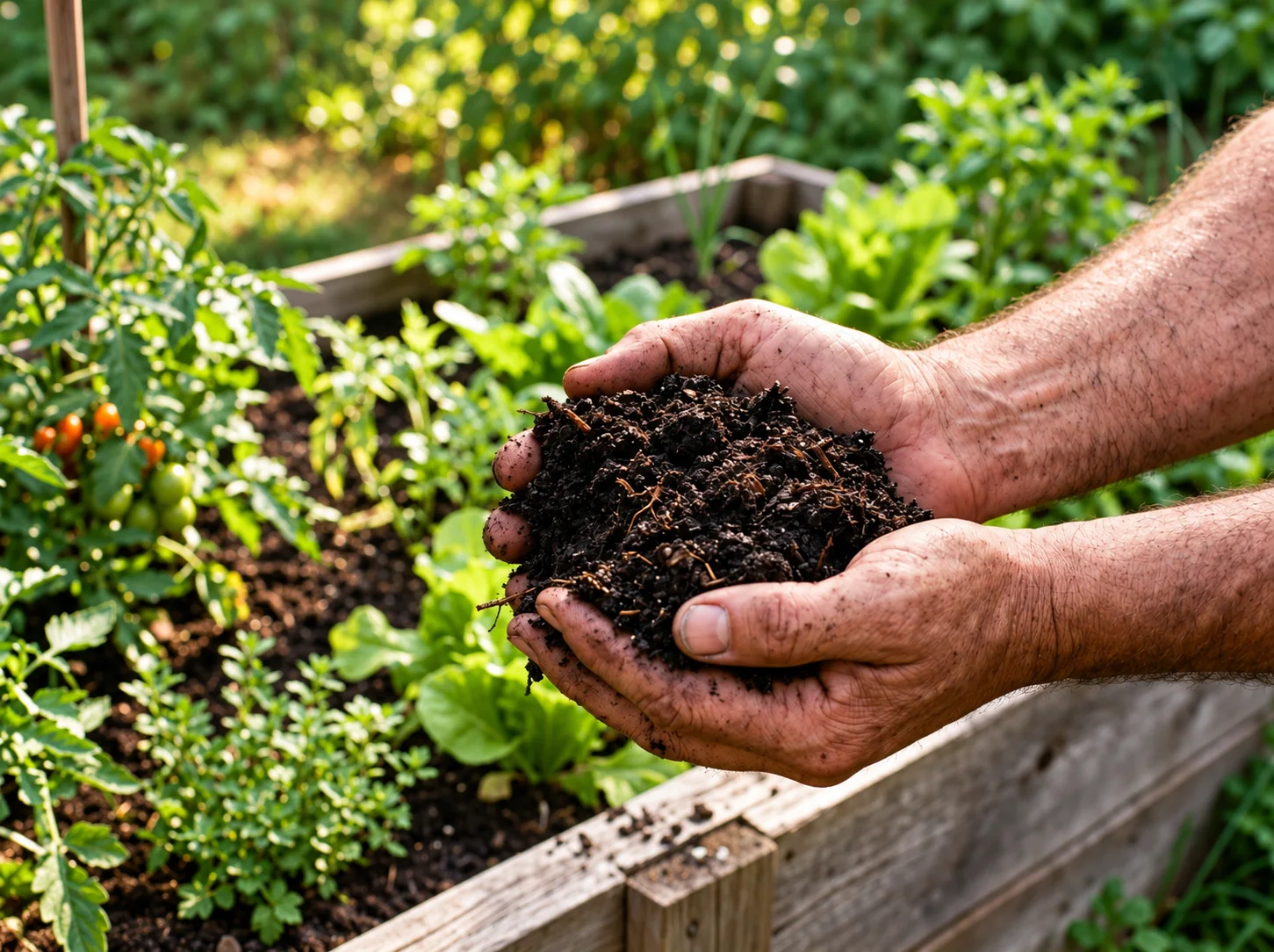
| 🟢 QUICK ANSWER BOX The best way to build healthy garden soil without synthetic fertilizers, herbicides, or pesticides is to improve the soil itself rather than constantly treating the plants. Start by testing your soil, adding appropriate organic matter such as finished compost, keeping the surface covered with mulch, reducing unnecessary tilling, and using living plants or cover crops whenever possible. These practices improve soil structure, support soil organisms, and help the soil hold and cycle water and nutrients more effectively. You do not need to transform your garden overnight. Healthy soil is built gradually, one season at a time. |
How Healthy Garden Soil Works
Your soil is much more than dirt. It is a living ecosystem containing minerals, organic matter, air, water, plant roots, fungi, bacteria, earthworms, and many other organisms.
Your soil is not just dirt. It is one of the most complex and beautifully organized living ecosystems on the planet. Even a small amount of healthy soil can contain an enormous community of microorganisms, including bacteria and fungi. These organisms help decompose organic material, cycle nutrients, and interact with plant roots. Billions of bacteria, thousands of feet of fungal threads, and dozens of different microscopic creatures all working together to break down organic matter, release nutrients, fight off pathogens, and feed plant roots continuously.
Synthetic fertilizers can supply nutrients directly to plants, but they do not replace the broader soil-building role of organic matter, living roots, soil cover, and biological activity. When nutrients are overapplied or poorly managed, they can also contribute to soil and environmental problems.
Relying only on soluble nutrients does not address other aspects of soil health, such as organic matter, soil structure, water management, and biological activity. Good organic gardening takes a broader approach by building the soil while meeting the nutritional needs of the plants.
Organic gardening takes a different approach.
Instead of feeding the plant, they feed the soil. They focus on building a living soil system that can support better structure, nutrient cycling, water management, and plant growth over time.
If you’re new to organic gardening, start with our Organic Gardening for Beginners: Complete USA Guide. It covers the complete process from choosing a garden location to growing and harvesting. This guide focuses specifically on building healthy soil.
What Is Healthy Garden Soil?
Healthy garden soil isn’t something you simply buy in a bag. It is a living system that you build and maintain over time.
USDA Natural Resources Conservation Service (NRCS) describes soil health as the continued capacity of soil to function as a living ecosystem that sustains plants, animals, and people. Healthy garden soil supports important functions such as water movement, nutrient cycling, plant growth, and biological activity. It filters and stores water efficiently. It cycles nutrients continuously. It supports plant and root growth. It provides habitat for billions of soil organisms. And it absorbs and stores carbon from the atmosphere.
Healthy soil may be dark and rich in organic matter, but color alone cannot tell you whether soil is healthy. Look at several characteristics together, including structure, drainage, organic matter, biological activity, and plant performance.
It crumbles easily in your hand without clumping into hard balls or breaking apart into dust. It drains well after rain but retains enough moisture to keep roots hydrated between watering sessions. And when you dig into it, you find earthworms.
You may also find earthworms and other signs of biological activity, although earthworm numbers vary naturally with soil type, climate, moisture, and management.
The Soil Food Web
The soil food web describes the interconnected community of organisms living in and around the soil. It includes bacteria, fungi, protozoa, nematodes, earthworms, insects, and many other organisms.
Bacteria and fungi play important roles in decomposing organic matter and transforming nutrients as organic materials break down.
Some protozoa and nematodes feed on bacteria and fungi. Their activity can help release nutrients into forms that become available to plants and other organisms.
Earthworms feed on organic material and microorganisms as they move through the soil. Their activity can help mix organic material into the soil and create channels that improve the movement of air and water. The material they leave behind, known as worm castings, contains organic matter and nutrients and can be used as a soil amendment.
When the soil food web is functioning well, biological activity contributes to nutrient cycling and helps create favorable conditions around plant roots. It is one part of the larger system that supports healthy plant growth.
A healthy soil food web does not mean you can ignore nutrient management altogether. Soil testing can help you understand whether your garden actually needs additional nutrients.
If you want to explore this topic in more depth, read our Living Soil Gardening: Why Your Soil Ecosystem Matters.
Why Healthy Soil Matters More Than Fertilizer
Feed the Soil, Not the Plant
Organic gardeners often use the phrase “feed the soil, not the plant.” But what does it actually mean in practice?
Synthetic fertilizers can provide plants with readily available nutrients, which can be useful when a soil is deficient in a particular nutrient. But fertilizer alone does not address every part of soil health. It does not replace organic matter, soil structure, living roots, soil cover, or the diverse biological community that helps nutrients cycle through the soil.
This is why organic soil building takes a broader approach. Gardeners can improve the soil itself while using soil tests and appropriate amendments to meet the nutritional needs of their crops.
When you add suitable organic matter such as finished compost, decomposed leaves, or plant residues, you provide food and habitat for a wide range of soil organisms. Their activity can contribute to nutrient cycling, soil structure, water management, and favorable conditions for plant roots.
With consistent management, soil conditions can improve over time. The pace and extent of that improvement depend on the starting soil, climate, crops, and gardening practices.
That is the difference between simply treating a plant and managing the growing environment around it.
What Healthy Soil Gives Your Garden
When soil structure, organic matter, water management, and biological activity are working together, plants can benefit in several important ways:
Better water management because soil with good structure and adequate organic matter can improve infiltration and water-holding capacity.
Favorable conditions around plant roots because soil structure determines how easily roots can access air, water, and nutrients.
Improved nutrient cycling because microorganisms and other soil organisms help break down organic material and transform nutrients within the soil ecosystem.
Better root development because well-structured soil provides roots with space to grow and access to air and water.
Greater plant resilience because appropriate soil conditions support healthy roots and overall plant growth. Healthy soil is one part of an integrated approach to managing environmental stress, pests, and diseases.
For practical organic pest management methods, see our How to Get Rid of Garden Pests Organically.
Signs of Healthy Garden Soil
Before you start adding amendments, it helps to understand what you are working with and what you want to improve.
No single sign can tell you whether soil is healthy. Look at several characteristics together, and use a soil test when you need information about pH and nutrient levels.

Dark Color
Soil color can provide clues about organic matter and drainage, but it is not a reliable stand alone measure of soil health. Dark soil may contain substantial organic matter, but healthy soil can occur in many different colors depending on its mineral content, moisture, and other characteristics.
Rather than judging soil by color alone, look at its structure, drainage, organic matter, biological activity, and plant performance.
Earthworm Activity
Earthworm activity can contribute to soil structure by creating channels that help air and water move through the soil. They aerate the soil with their tunnels, improving drainage and allowing roots to penetrate deeply. They process organic matter through their digestive systems and produce worm castings that are extraordinarily rich in plant available nutrients and beneficial microorganisms.
There is no universal number of earthworms that defines healthy garden soil. Earthworm populations vary naturally with soil type, climate, moisture, organic matter, and management.
Finding earthworms is encouraging, but their absence does not automatically mean your soil is unhealthy.
Good Drainage and Crumbly Texture
Healthy soil absorbs water quickly without pooling on the surface and without washing away. After rain, the soil should be moist several inches deep without becoming waterlogged. Healthy soil crumbles into loose granules when you squeeze a handful. It should never form a hard brick when dry or a sticky paste when wet.
Strong and Fast Plant Growth
Healthy garden soil can support strong plant growth, but plant performance also depends on sunlight, temperature, water, nutrients, genetics, and pest and disease pressure. If vegetables consistently underperform despite suitable light and watering, soil conditions are worth investigating.
| Healthy Soil | Unhealthy Soil |
|---|---|
| Dark brown to black color | Pale gray or tan color |
| Crumbles easily in hand | Hard when dry, sticky when wet |
| Many earthworms visible | Few or no earthworms present |
| Drains well after heavy rain | Standing water or fast runoff |
| Rich earthy smell | Sour, chemical, or no smell |
| Plant roots penetrate deeply | Roots stay near surface |
| Minimal pest and disease problems | Frequent infestations |
| Consistent high yields each season | Declining yields over time |
Test Your Soil Before Making Any Changes
One of the easiest ways to waste money in the garden is to add amendments without first understanding what your soil needs. A simple soil assessment can tell you whether you’re dealing with sandy soil, heavy clay, compaction, unusual pH, or a nutrient imbalance.
You don’t need a laboratory for every observation. Start with a simple texture check, then use a soil test when you need information about pH and nutrients
Soil Texture Test
You can get a rough idea of your soil texture without special equipment. Take a small handful of moist garden soil and squeeze it firmly in your hand. Then open your hand and gently poke or squeeze the soil.
If it feels gritty and falls apart easily, it is likely sandy. If it feels smooth, sticky, and holds together strongly when wet, it may contain a high proportion of clay. If it holds together briefly but breaks apart relatively easily, it may have a loamy texture.
Loam is often convenient for vegetable gardening because it can provide a useful balance of drainage, water retention, and workability. However, clay and sandy soils can also be productive when they are managed appropriately.
This is only a simple home test. A laboratory soil test provides more reliable information about your soil’s properties and nutrient levels.
pH Testing
Soil pH measures how acidic or alkaline soil is on a scale from 0 to 14. Many vegetables grow well in slightly acidic to neutral soil, often around pH 6.0 to 7.0, although the preferred range varies by crop.
Soil pH affects the availability of different nutrients. When pH moves too far outside the preferred range for a particular crop, some nutrients can become less available to plant roots.
Basic home pH tests are widely available at garden centers and online, while laboratory tests provide more detailed information. Testing costs vary by provider and by the type of analysis requested.
For US gardeners, your state Cooperative Extension service can be a useful source of soil-testing information and locally appropriate amendment recommendations. The Cooperative Extension network, supported by land-grant universities across the United States, is one of the most useful sources of region-specific gardening information.
Add Organic Matter First
Maintaining appropriate organic matter is one of the most useful ways to improve many garden soils. Compost, decomposed leaves, plant residues, and other organic materials can improve soil structure and support biological activity over time.
Organic matter provides food and habitat for soil organisms, can improve soil structure, and can help clay soils with water movement while helping sandy soils retain moisture and nutrients. It also contributes nutrients as it decomposes, although the amount and availability vary considerably between materials.

Compost
Finished compost is one of the most useful organic amendments for many home gardens. It adds organic matter and can contribute nutrients while supporting biological activity and improving soil structure.
For a new garden bed, compost can be incorporated into the soil when appropriate. In established or no-dig beds, a surface application can be left in place so rainfall, roots, and soil organisms gradually incorporate it. The appropriate amount depends on the condition of the soil and the quality of the compost.
For containers and raised beds, a small surface application of finished compost can be used as a top dressing when appropriate. Follow the needs of the particular crop and growing medium rather than applying a fixed amount automatically.
Homemade compost can be an inexpensive way to produce a useful soil amendment from kitchen scraps and garden materials when the composting process is properly managed.
For a complete guide, read our How to Make Compost at Home: Step-by-Step
Worm Castings
Worm castings are the processed organic material produced by composting worms. Their nutrient content varies depending on the feedstock and production system, but they can contribute organic matter and nutrients to garden soil and growing mixes.
For containers, follow the application instructions provided with the product. In garden beds, worm castings can be used as a modest amendment or top dressing rather than as a replacement for soil testing and nutrient management.
Aged Manure / Properly Composted Manure
Properly composted manure can be a useful source of organic matter and nutrients. Fresh or inadequately composted manure can contain pathogens and may damage plants because of its high nutrient and ammonia content.
For edible crops, follow current food-safety guidance for manure use, including recommended intervals between application and harvest. Application rates should also be based on soil conditions, crop needs, manure quality, and local recommendations.
Leaf Mold
Leaf mold is decomposed leaf material and can be a useful, inexpensive soil amendment. It does not provide large amounts of nutrients, but it can improve soil structure and moisture management.
To make leaf mold, collect clean fallen leaves in a simple pile or wire enclosure and allow them to decompose. Shredding the leaves first can speed up the process. Depending on conditions, useful leaf mold may take a year or longer to develop.
Organic Soil Amendments at a Glance:
| Amendment | Main benefit | General guidance |
|---|---|---|
| Finished compost | Organic matter, structure, nutrient cycling | Apply according to soil condition and compost quality |
| Worm castings | Organic matter and nutrients | Follow product instructions |
| Properly composted manure | Organic matter and nutrients | Follow food-safety and local guidance |
| Leaf mold | Structure and moisture management | Use as a surface amendment or mulch |
| Wood-chip mulch | Moisture conservation and surface protection | Apply as surface mulch |
| Cover crops / green manure | Soil cover, living roots, biomass | Choose species and timing for your climat |
Mulching for Long Term Soil Health
Mulching is one of the simplest ways to protect garden soil while reducing some routine maintenance.
A layer of organic mulch around established plants can reduce evaporation from the soil surface, moderate soil temperature, suppress weeds, and protect the surface from rain impact. The appropriate depth depends on the mulch material and the plants being grown.
Organic mulch can also reduce surface crusting, helping water move into the soil more easily.
As plant-based mulch gradually decomposes, it adds organic material to the garden and provides food and habitat for soil organisms. The speed of decomposition depends on the material, weather, moisture, and soil conditions.
Common organic mulches for vegetable gardens include straw, shredded leaves, and suitable wood chips. For vegetable beds, choose clean materials from a known source and avoid products that may contain contaminants. Some hay can contain viable weed seeds, so weed-free straw is often a better choice for food gardens.
For more ways to manage weeds without synthetic herbicides, see our: Organic Weed Control: 8 Chemical-Free Methods.
Grow Cover Crops Between Seasons

Cover crops are one of the most useful tools available to gardeners who want to protect and improve soil between growing seasons. They are plants grown primarily for purposes such as soil cover, living roots, biomass, biodiversity, or nutrient management rather than for harvesting as a main food crop.
Cover crops can protect exposed soil from erosion and heavy rain. Depending on the species, their roots can contribute to soil structure and water movement. When properly terminated, the plant material becomes part of the organic matter cycling through the garden.
Legume cover crops can also contribute nitrogen through their relationship with nitrogen-fixing bacteria, while grasses and other non-legume cover crops are often valued for their biomass, root systems, and soil-cover benefits..
Cover Crops to Consider for a Home Garden
Winter rye is a popular cool-season cover crop because it tolerates cold conditions and produces substantial biomass. Planting dates depend on your climate and local growing season.
Crimson clover is a legume that forms a relationship with nitrogen-fixing bacteria in its root nodules. It can provide soil cover, biomass, and flowers that attract pollinators.
Austrian winter peas are another cool-season legume option. Their ability to survive winter depends on local temperatures and planting timing, so check recommendations for your area before relying on them as an overwintering crop.
Buckwheat grows quickly during warm weather and can provide rapid ground cover. When established densely, it can suppress some weeds and its flowers can attract pollinators.
Reduce Tilling and Soil Disturbance
Many traditional gardening methods rely heavily on turning and loosening the soil before each planting season. However, soil health research has shown that repeated or intensive disturbance can work against the soil structure and biological activity gardeners are trying to build.
Repeated tillage can break apart soil aggregates and disrupt fungal networks and other soil organisms. It can also expose buried weed seeds to favorable conditions for germination and increase the risk of erosion and organic-matter loss.
The goal is not to say that every instance of tilling is harmful. Rather, it is to ask whether the disturbance is necessary for the job you are trying to accomplish.
Why No Dig Gardening Works
No dig gardening generally minimizes soil disturbance by building and maintaining garden beds from the surface rather than routinely turning the soil. Compost and mulch are commonly used as surface amendments.
USDA NRCS identifies minimizing soil disturbance as one of its core soil health principles. Many university Extension programs also provide guidance on reduced-tillage and soil-building approaches.
Reducing unnecessary disturbance can help preserve soil structure and biological habitat. Over time, continued soil cover, organic matter additions, and living roots can support biological activity and improve soil conditions.
Some gardeners may notice practical changes within a growing season, while larger changes in soil structure and organic matter can take several seasons or longer. The timeline depends on the starting soil, climate, crops, and management practices.
For a complete guide to setting up a no-dig garden system from scratch, read our: How to Start a No-Dig Garden: The Easiest Method.
Keep Living Roots in the Soil Year Round
Living roots are an important part of a healthy soil ecosystem. USDA NRCS identifies keeping living roots in the soil as one of its core soil-health principles.
An empty garden bed may look like it is resting, but soil is generally better protected when living roots or suitable plant cover remain in place.
Living roots are active participants in the soil ecosystem. They release compounds known as root exudates, including sugars and other carbon-containing compounds, into the surrounding soil. These compounds are an important source of carbon for many microorganisms living in the rhizosphere, the zone of soil influenced by plant roots.
When living roots disappear, the supply of root-derived carbon also decreases. Microbial activity can change as a result, although the extent of the change depends on soil conditions, organic matter, moisture, temperature, and how long the soil remains without living plants.
When practical, avoid leaving garden beds bare for long periods. Plant cover crops between growing seasons, use succession planting, and choose crop combinations that help you keep living plants and roots in the garden for more of the growing season.
For ideas on combining compatible crops, see our: Companion Planting: Which Plants Help Each Other
How to Improve Clay Soil Naturally
Clay soil can be challenging to work with. It may become sticky when wet, hard when dry, and slow to drain when compacted. But clay also has an important advantage: its fine particles can hold substantial amounts of water and nutrients.
The goal is not to eliminate the clay. Instead, improve its structure and create better conditions for roots, water, air, and soil organisms.
Don’t add a small amount of sand to clay soil simply to improve drainage. Without the right proportions, sand and clay can produce a dense mixture that is harder to work with rather than improving the soil.
Instead, build organic matter gradually with appropriate materials such as finished compost, decomposed plant residues, or other suitable amendments. Organic matter can improve aggregation and help create more favorable conditions for water movement and root growth.
Organic matter can also support soil organisms, including earthworms, while contributing to the formation and stability of soil aggregates. Together, these processes can improve pore space and water movement over time.
A layer of suitable wood-chip mulch can protect the soil surface from rain impact, temperature extremes, and foot traffic. It can also help reduce moisture loss from the surface.
Avoid working clay soil when it is very wet, because traffic and tillage can damage its structure and create compaction. Work the soil when it is moist enough to crumble rather than smear.
With consistent management, clay soil can become easier to work and more productive over time. The pace of improvement depends on the starting soil, climate, organic-matter inputs, drainage, and how much the soil is disturbed.
How to Improve Sandy Soil Naturally
Sandy soil generally drains quickly and has less capacity to hold water and some nutrients than soils with more clay and organic matter.
Water and dissolved nutrients can move through sandy soil quickly, especially after heavy watering or rainfall. The goal is to improve water and nutrient retention while preserving the good drainage that sandy soil naturally provides.
As with clay soil, maintaining appropriate organic matter can help. Compost and other suitable organic materials can increase the soil’s ability to retain water and nutrients while still allowing excess water to drain.
Coconut coir can be useful in container and raised-bed growing mixes because it holds moisture while maintaining relatively good aeration. For outdoor garden beds, compost and other locally appropriate organic materials are usually a more practical starting point.
Mulching can be particularly useful in sandy soil because it reduces evaporation from the surface and helps protect the soil from drying out quickly.
If you’re working with containers or raised beds, the growing medium itself becomes especially important. See our guide to Best Organic Potting Mix for Vegetables: Top 5
How Long Does It Take to Build Healthy Soil?
This is one of the most common questions gardeners ask, and there is no single timeline that applies to every garden.
You may notice some changes during the first growing season, especially in surface moisture, soil structure, or how easily the soil can be worked. Larger changes in soil organic matter and biological activity generally take longer.

Within three months of adding two to three inches of compost and applying mulch, most gardeners notice darker soil color, improved water retention, and better plant growth. Earthworm populations begin recovering noticeably in areas that were previously low.
After one full year of consistent organic matter additions, cover cropping, and minimal tilling, the transformation becomes genuinely striking. Soil texture improves measurably. Drainage becomes noticeably better in clay and moisture retention improves in sand. Yields increase. Plant health problems decrease.
After three years of consistent organic soil building practices, most home gardeners find that their soil has transformed into something genuinely productive that requires far less amendment than it did initially. The soil biology has established itself enough to cycle nutrients more independently, hold moisture more efficiently, and support much stronger plant root development.
The most important thing to understand about this timeline is that the benefits compound. Every season of organic matter addition builds on the previous one. Year three soil is not just three times better than year one soil. It is exponentially better because the living biology in it has had years to multiply, connect, and establish the deep networks that make a soil genuinely self sustaining.
Common Mistakes That Damage Soil Health
Over Tilling
Repeated or unnecessarily intensive tillage can damage soil structure and disrupt soil organisms, especially when soil is worked under poor conditions.
Repeated disturbance can disrupt fungal networks, soil aggregates, and other parts of the soil ecosystem. Whenever practical, minimize unnecessary soil disturbance and use surface amendments and mulch instead of routinely turning the entire bed.
Adding Fresh Manure Near Harvest
Fresh or inadequately composted manure can contain pathogens that may contaminate edible crops. For vegetable gardens, use properly composted manure and follow current food-safety recommendations for manure application and harvest intervals.
If you’re growing food, check guidance from USDA, FDA, or your state Cooperative Extension service rather than relying on a fixed “six-month” rule.
Leaving Soil Bare Between Seasons
Exposed soil is more vulnerable to erosion, surface crusting, moisture loss, and temperature extremes. Keeping soil covered with living plants or suitable mulch can help protect it between growing seasons.
Living roots also provide carbon to microorganisms in the rhizosphere. When practical, use cover crops or mulch to protect beds during extended periods between food crops.
Ignoring Soil pH
Soil pH affects nutrient availability. When pH is too high or too low for a particular crop, some nutrients may become less available to plant roots.
Test soil pH periodically, particularly when establishing a new garden, seeing unexplained plant problems, or considering a major amendment. Lime is commonly used to raise soil pH when a soil test indicates that it is too acidic. Elemental sulfur can lower pH when appropriate, but application rates should be based on a soil test and local recommendations.
Adding Too Much Compost at Once
Soil pH affects nutrient availability. When pH is too high or too low for a particular crop, some nutrients may become less available to plant roots.
Test soil pH periodically, particularly when establishing a new garden, seeing unexplained plant problems, or considering a major amendment. Lime is commonly used to raise soil pH when a soil test indicates that it is too acidic. Elemental sulfur can lower pH when appropriate, but application rates should be based on a soil test and local recommendations.
Building Healthy Soil on a Budget
Improving garden soil does not require an expensive trip to the garden center. Many useful soil-building materials can be made, collected, or sourced locally for little or no cost.
Kitchen scraps and suitable garden materials can become compost. A simple compost bin can be inexpensive to build and can turn otherwise discarded organic materials into a useful soil amendment over time.
Autumn leaves are another valuable resource. Collect leaves from your own yard or ask neighbors if they are willing to share them. Shredded leaves can be used as mulch or added to a leaf mold pile for longer term decomposition.
Many cities, counties, parks departments, utility companies, and tree care programs make wood chips available to residents. Availability varies by location, so check local programs before buying mulch.
Some coffee shops also set aside used coffee grounds for gardeners. Used grounds contain organic material and some nitrogen, but they should not be treated as a complete fertilizer. Add them to compost or use them in moderation rather than applying thick layers directly to garden soil.
Grass clippings from your own lawn can also be useful in compost or as a thin mulch layer, provided the lawn has not recently been treated with herbicides or other products that could affect garden plants.
Where to Spend Your Money First
If your gardening budget is limited, spend money on information before buying a long list of amendments. A soil test can help you avoid purchasing products your soil doesn’t need.
After that, prioritize basic materials that improve soil cover and organic matter, such as compost, mulch, or locally available leaf material. Many gardeners can source at least some of these materials for little or no cost.
You do not need worm castings, specialty soil additives, microbial inoculants, or expensive fertilizers to start improving garden soil. Use them only when they have a clear purpose for your particular garden.
Connecting Soil Health to Everything Else in Your Garden
When your soil is alive and healthy, many other aspects of organic gardening can become easier to manage and more rewarding.
Organic fertilizers work within the broader soil ecosystem. Soil microorganisms can help decompose and transform organic materials, while soil structure and moisture influence how nutrients move toward plant roots. Learn more about choosing organic fertilizers for vegetables: Best Organic Fertilizers for Vegetables: Top 6
Healthy soil can provide tomato plants with better conditions for root growth, water management, and nutrient availability. Soil health is one part of successful tomato production, alongside variety selection, sunlight, watering, temperature, and pest and disease management. Learn more in How to Grow Organic Tomatoes from Seed to Harvest.
Healthy growing conditions can support vigorous herb growth, while flavor and aroma also depend on the herb species, variety, light, temperature, water, nutrition, and harvest timing. Learn more in How to Grow Herbs Organically.
Frequently Asked Questions
What makes soil healthy?
Healthy garden soil has good structure, adequate organic matter, appropriate water and air movement, active biological processes, and nutrient and pH conditions that support the plants being grown. Soil health isn’t defined by one characteristic or one soil color. It is the soil’s ability to function effectively as a living system.
How do you improve garden soil naturally?
Start by understanding your soil through observation and, when appropriate, a soil test. Then focus on practices such as maintaining appropriate organic matter, using mulch to protect the soil surface, growing cover crops when suitable, reducing unnecessary soil disturbance, and keeping living roots in the soil when practical. The right combination depends on your soil, climate, crops, and growing system.
Can compost replace fertilizer?
Compost can contribute organic matter and nutrients, but it should not automatically be treated as a complete replacement for fertilizer. Nutrient content varies by compost source, and some crops or soils may still require additional nutrients. A soil test can help determine whether supplemental fertilizer is needed.
How long does it take to build healthy soil?
Soil improvement is gradual, and there is no universal timeline. You may notice practical changes during the first growing season, while larger changes in soil structure and organic matter can take several seasons. The timeline depends on the starting soil, climate, rainfall, crops, organic matter inputs, and management practices.
What are signs of unhealthy soil?
Potential signs of soil problems include persistent compaction, poor water infiltration, prolonged standing water, excessive runoff, very low organic matter, restricted root growth, or recurring plant-growth problems. Soil color and visible organisms can provide clues, but they should not be used alone to judge soil health. A soil test can provide additional information about pH and nutrient levels.
Is tilling bad for soil?
Frequent or intensive tillage can disrupt soil aggregates, fungal networks, and other parts of the soil ecosystem. Reducing unnecessary disturbance can help preserve soil structure and biological habitat. However, the best approach depends on the garden system, soil, crops, and reason for tilling.
CONCLUSION: Build Your Soil One Season at a Time
Building healthy garden soil without chemicals is not a complicated project. It is a patient one.
Start by understanding what you already have. Check your soil’s texture, consider a soil test when appropriate, and then address the specific problems you find.
Add appropriate organic matter. Protect the surface with mulch. Grow cover crops when they fit your climate and planting schedule. Reduce unnecessary soil disturbance, and keep living roots in the soil whenever practical.
You won’t transform every garden overnight, and there is no single recipe that works for every soil type. But consistent improvements can add up over time, creating better conditions for roots, water, nutrients, and the organisms that make up the soil ecosystem.
Start with one change this season. Build from there.
This article is part of our complete organic gardening series. For the broader beginner guide covering garden setup, planting, maintenance, and harvesting, start with our Organic Gardening for Beginners: Complete Guide
References
These are the sources I would use for the article’s factual foundation.
1. USDA Natural Resources Conservation Service: Soil Health
Useful for the definition of soil health, soil functions, living roots, soil cover, biodiversity, and minimizing disturbance.
2. USDA NRCS: Role of Organic Matter
Useful for organic matter, soil structure, water infiltration, nutrient cycling, and water-holding capacity.
USDA NRCS: Role of Organic Matter
3. USDA NRCS: Soil Health Management
Useful for living roots, soil cover, biodiversity, and reducing soil disturbance.
USDA NRCS: Soil Health Management
4. USDA NRCS: Minimizing Soil Disturbance
Useful for the discussion of tillage, soil structure, erosion, organic matter, and soil organisms.
USDA NRCS: Minimizing Soil Disturbance
5. USDA NRCS: Healthy Soils for Organic Farming
Useful for connecting soil-health principles specifically with organic farming, including crop diversity, cover crops, reduced disturbance, and living plants.